LA PALMA, Spain — The star was a little smaller than the sun, and it had the misfortune to wander too close to the center of its galaxy. In a matter of days it was stretched into a stream of hot gas, half of which spiraled into a black hole six million times the mass of the sun. The rest was flung into space.
Astronomers have seen such deaths before, but rarely from the start. On Saturday, a European team published the most complete record yet of a tidal disruption event, as the phenomenon is known, after catching the flare within 14 hours of its onset and following it for 90 consecutive nights from observatories on La Palma, in Chile and in orbit.
“Normally we arrive at the funeral,” said Ingrid Thorsby, an astrophysicist at Stockholm University and lead author of the paper in The Astrophysical Journal Letters. “This time we were there for the whole thing, and the first two weeks turned out to be where all the physics is.”
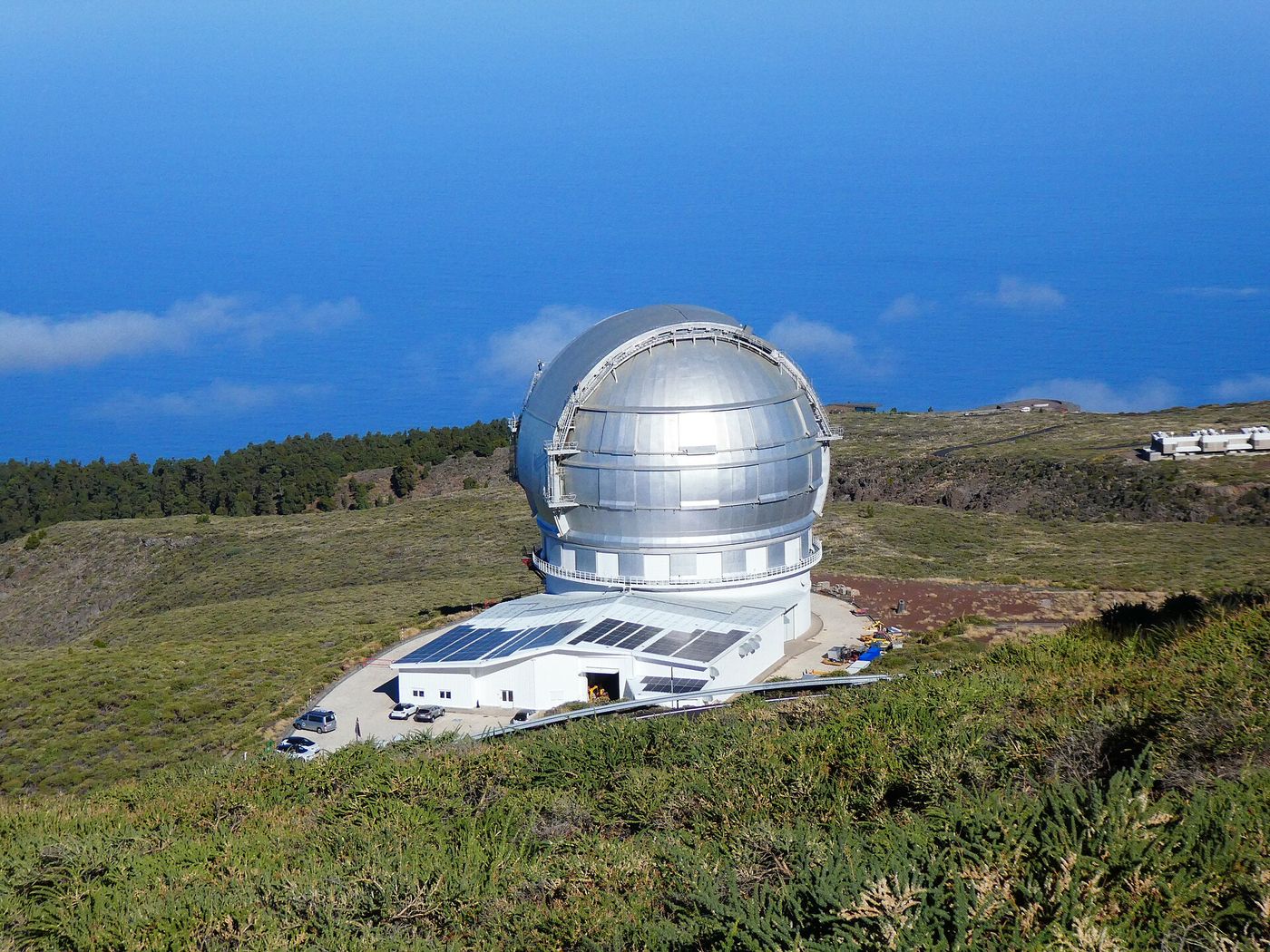
The event, cataloged as AT 2026nvk, occurred in a galaxy about 420 million light-years away in the constellation Boötes. It was flagged on June 2 by an automated survey telescope, and within hours the Gran Telescopio Canarias had taken its first spectrum. The flare brightened roughly a thousandfold over 11 days before fading slowly through the summer.
What makes the data set unusual is polarization — a measure of how the light’s waves are aligned — recorded night after night. The team found that the polarization swung sharply during the first week, which they interpret as the debris stream colliding with itself and forming a disk around the black hole. Theorists have argued for two decades about whether that disk forms quickly or slowly. “Quickly,” Dr. Thorsby said. “Days, not months.”
Paolo Ferrante, a co-author at the Italian National Institute for Astrophysics in Rome, said the result could sharpen estimates of how many of these events are occurring across the universe. Current surveys catch perhaps 20 a year; a new European survey telescope due to begin operations in 2028 is expected to find hundreds. “We are about to be flooded,” he said. “It is nice to have one textbook example to calibrate against.”
The paper also reports a faint radio signal that appeared about 40 days in, consistent with a slow outflow of gas rather than a powerful jet. Some researchers had expected jets to be more common. “Nature is more modest than our simulations,” Dr. Ferrante said.
The star itself, the authors estimate, had about 80 percent of the sun’s mass and was probably several billion years old. “It had a long life,” Dr. Thorsby said. “The end was fast.”
A version of this article appears in print on Oct. 11, 2026, Section A, Page 5 of the European edition with the headline: From a Canary Island Peak, Astronomers Watch a Black Hole Tear a Star Apart in Record Detail.