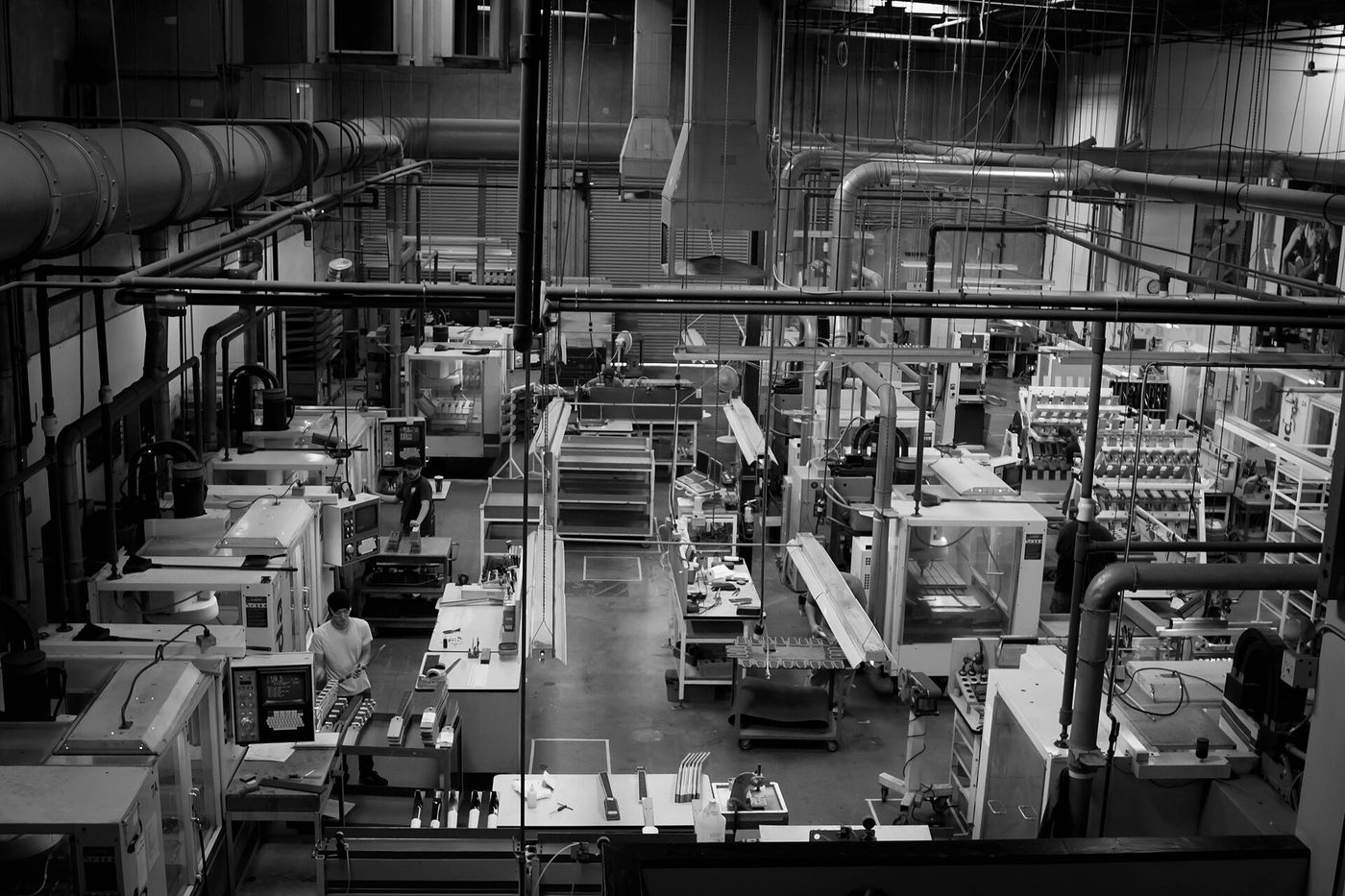
STUTTGART, Germany — For three generations, the machine shops of Baden-Württemberg built the machines that built everything else: the five-axis mills that cut turbine blades, the grinders that finish gears to a thousandth of a millimeter, the lathes that turn out car parts in Guangzhou and Detroit alike. On Friday, the industry’s trade association delivered a warning its members have been dreading: foreign orders fell 14 percent in the first nine months of 2026, and Chinese manufacturers are now winning contracts in the precision segments Germany once owned.
The German Machine Tool Builders’ Association said production this year would fall to about 12.1 billion euros, roughly $13 billion, the lowest level since 2010 excluding the pandemic, and that as many as 20,000 of the sector’s 68,000 jobs could disappear by 2028 without a change in course.
“We used to compete with the Japanese and the Swiss on quality and with the Chinese on price, and we knew which fight we were in,” said Dr. Markus Reinhardt, the association’s executive director. “Now the Chinese are in the quality fight, and they are still charging the price-fight price.”
The shift has been swift. As recently as 2020, Chinese machine tool makers were largely confined to the lower end of the market. Since then, heavy state investment, a domestic electric vehicle boom that demanded sophisticated tooling, and the hiring of hundreds of engineers from European and Japanese firms have pushed Chinese companies into five-axis machining and ultra-precision grinding. A survey by the association found that 38 percent of German customers abroad had considered a Chinese alternative in the past year, up from 9 percent in 2021, and that Chinese machines were on average 35 percent cheaper.
Rising energy costs, a weak domestic automotive sector and a strong euro have compounded the problem. Germany’s carmakers, historically the industry’s largest customers, cut capital spending by about a fifth this year as they absorbed losses on electric models.
In Göppingen, east of Stuttgart, Friedrich Haller, 63, is the third generation to run a family firm that makes grinding machines and employs 240 people. He has lost two long-standing customers in Turkey and Mexico to Chinese bids this year. “A customer called me and said, Herr Haller, the Chinese machine is as good as yours, and it is 400,000 euros cheaper, give me one reason,” he said. “I gave him three. He bought the Chinese machine.”
The association called for lower electricity prices for industry, faster depreciation rules and a European response to what it described as Chinese dumping. Economists are skeptical that policy can do much. “The German model was based on a technological lead that no longer exists in large parts of this sector,” said Prof. Claudia Ebner of the ifo Institute in Munich. “The firms that survive will be those that move into services, software and the niches where tolerances are so tight that nobody else can play. That is a smaller industry.”
Mr. Haller said he was not ready to concede. His firm is developing a machine that uses sensors and software to compensate for thermal drift in real time, something he says Chinese competitors cannot yet match. “They will match it in three years,” he said. “So I have three years.”
A version of this article appears in print on Oct. 11, 2026, Section B, Page 17 of the European edition with the headline: Germany’s Machine Tool Makers, Long the World’s Benchmark, Confront a Chinese Challenge They Didn’t See Coming.