WROCŁAW, Poland — The first thing to know about Wrocław is that it is pronounced, roughly, VROTS-wahf, and the second is that it has spent most of its history under other names. It was Vratislavia to the medieval Bohemians, Breslau to the Prussians and Germans who held it from 1741 to 1945, and a ruin when the Poles who were expelled from Lwów, now in Ukraine, arrived to rebuild it. They did, brick by brick, and the result is a city that looks older than it is and feels younger than it looks.
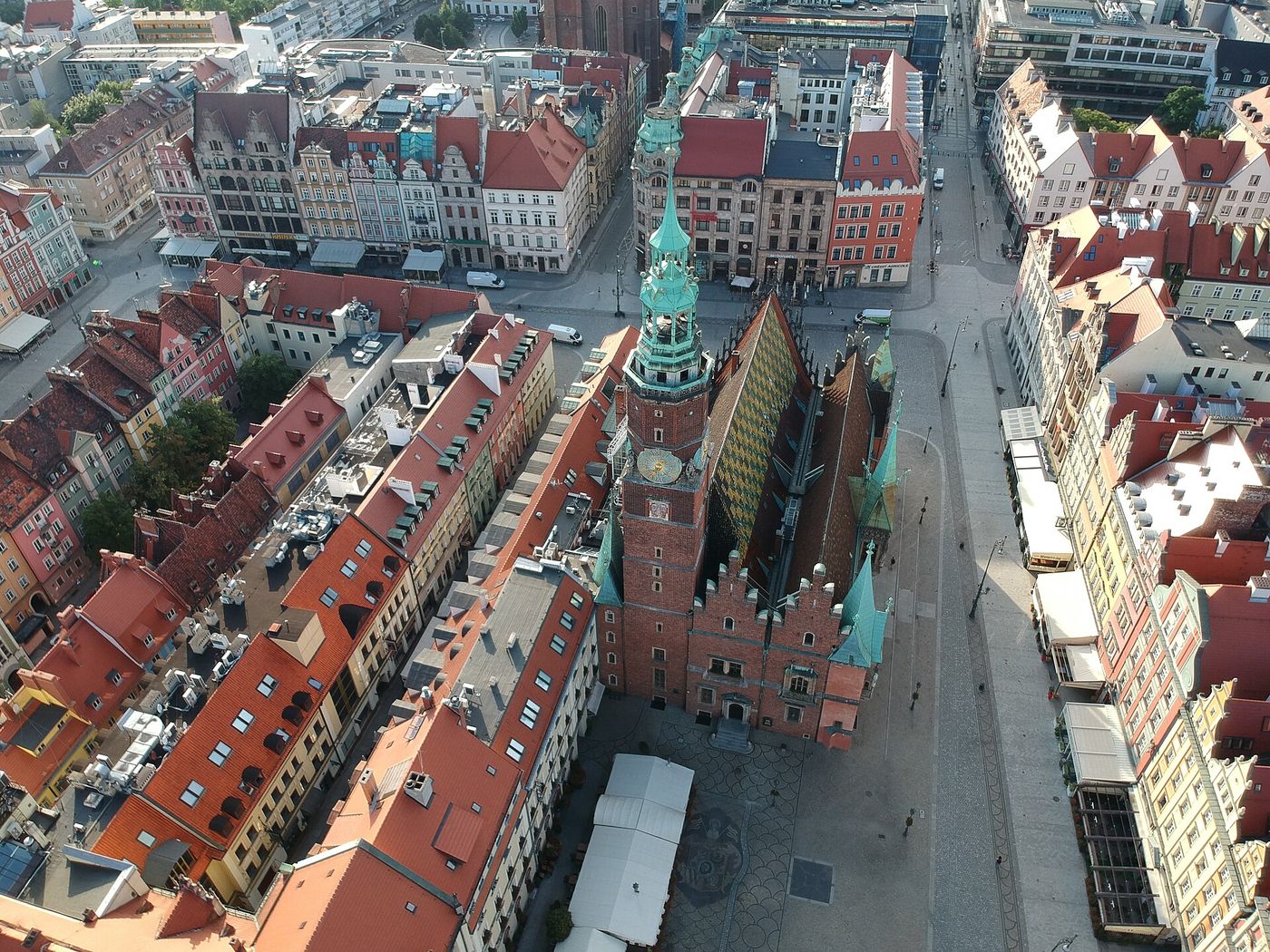
Start at the Rynek, the market square, on Friday evening. It is one of the largest in Europe, 3.8 hectares, ringed by townhouses in every color a 1950s restorer could mix and anchored by a Gothic town hall whose astronomical clock dates to 1580. Unlike Kraków’s square, this one is not yet a stage set; students from the city’s 12 universities drink beer on the steps of the fountain, and the cafes charge local prices. A half-liter at Przedwojenna, a corner bar that has not changed its décor or its 8-zloty price, about 2 euros, in 20 years, is the correct first move.
Saturday belongs to the water. The city sits on the Oder and four tributaries, split across 12 islands and crossed by more than 100 bridges, and the way to see it is from the river. Boats leave from the embankment below the cathedral every hour; a 50-minute loop costs 45 zloty. Get off at Ostrów Tumski, the cathedral island, where a lamplighter in a cape still lights the 103 gas lamps each evening at dusk, a job the city has refused to automate. The island’s two-towered cathedral, 90 percent destroyed in 1945, was rebuilt from photographs.
Lunch should be at a milk bar, the subsidized canteens that survived communism. Bar Mleczny Miś, on Kuźnicza Street, serves pierogi with buckwheat and mushrooms, cabbage soup and compote for about 25 zloty. “My grandmother ate here as a student. Now I eat here as a student,” said Agnieszka Wójcik, 22, a law student, waiting in line on Saturday. “The soup is the same. The prices are not, but they are still the best in the city.”
The afternoon is for the Four Domes Pavilion, part of the modernist exhibition complex built in 1913 around the Centennial Hall, a reinforced-concrete dome that was the largest in the world when it opened and that is now a UNESCO site. The pavilion holds the National Museum’s collection of Polish art after 1945, and the surrounding park, with its pergola and Japanese garden, is where the city goes on a fine afternoon.
Dinner is where Wrocław has changed most. The city’s restaurant scene, led by a generation of cooks who trained in Copenhagen and Warsaw and came back, now has three places with Michelin stars. Restauracja Bulwar, on the embankment, serves a seven-course menu built on Silesian ingredients, including a smoked trout from the Barycz ponds that is worth the trip alone, for 320 zloty, about 75 euros. Book two weeks ahead.
Sunday morning, walk. The city has scattered more than 400 bronze dwarves, each about 30 centimeters high, across its streets, a joke that began with an anti-communist art movement in the 1980s and has become a scavenger hunt for children and, late at night, adults. There is a map; ignore it.
Then take the tram to the Nadodrze district, north of the river, where the 19th-century tenements survived the war and now house the galleries, bakeries and bars that Kraków’s Kazimierz had 15 years ago. A cardamom bun and a flat white at Café Rozrusznik, in a former electrical workshop, is 22 zloty. The owner, Marcin Lewandowski, 38, who came back from Dublin to open it, said the neighborhood was still deciding what to be. “Come back in five years,” he said. “Or come now, before it decides.”
A version of this article appears in print on Oct. 12, 2026, Section A, Page 12 of the European edition with the headline: A Weekend in Wrocław, the Polish City of 100 Bridges and a Market Square That Rivals Kraków’s.