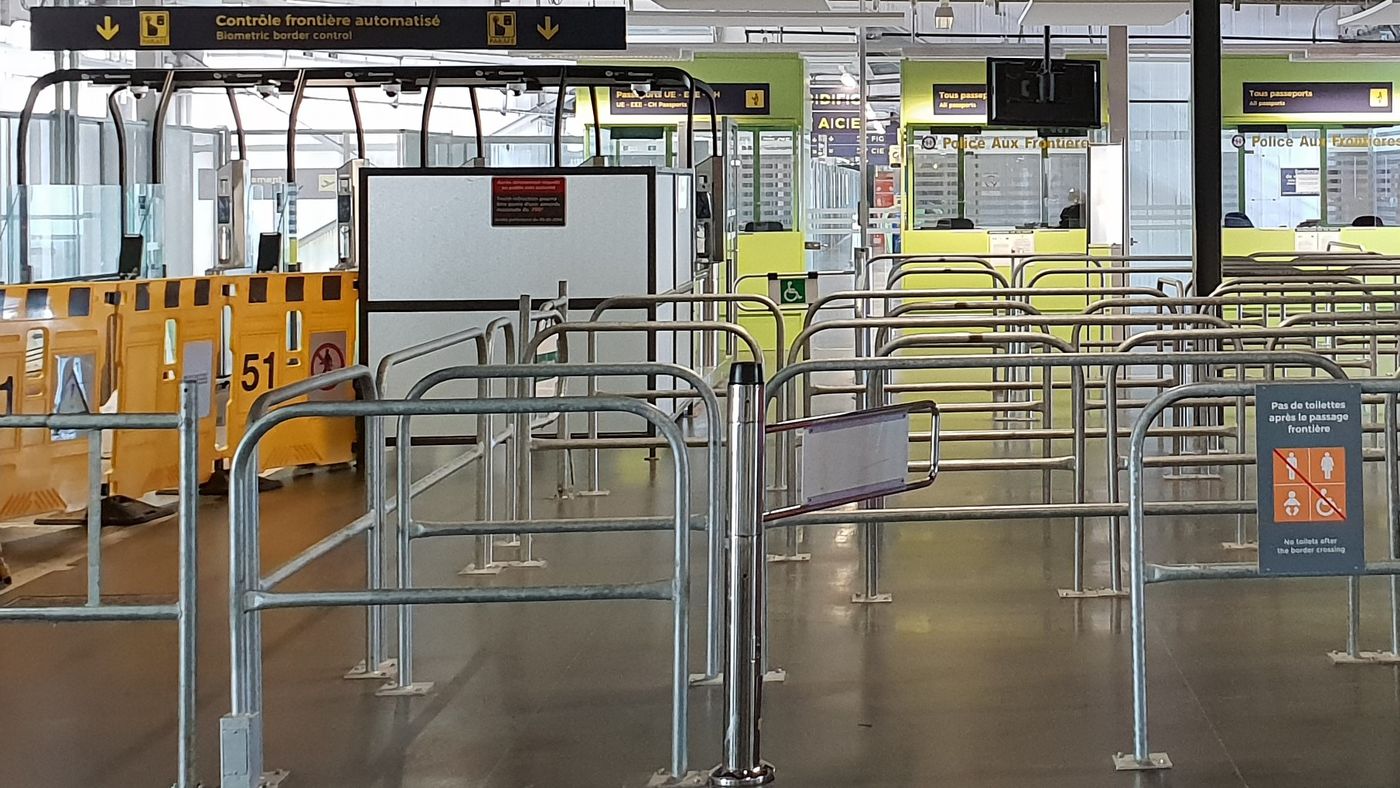
PARIS — At the Gare du Nord on Friday morning, the line for the London train moved at the pace it has moved for most of the past year: about 45 seconds per traveler at the kiosks where non-E.U. passengers place four fingers on a glass plate and look into a camera, then another minute at the booth. A family of four from Toronto, traveling on a 9:10 departure, cleared both in 14 minutes. “We were told to arrive two hours early,” said the father, Graham Pelletier. “We could have had breakfast.”
The Entry/Exit System, the European Union’s long-delayed replacement for the passport stamp, completed its phased introduction in April after launching at a handful of ports in October 2025. It now records every entry and exit by travelers from outside the bloc’s open-border zone at 1,800 crossing points in 29 countries, storing fingerprints and a facial image on first registration and, in theory, catching anyone who overstays the 90-day limit. The European Commission said on Thursday that the system had logged 160 million crossings and registered 61 million individual travelers.
The early months were rough. In November 2025, waits at Lisbon’s airport exceeded three hours on several days, and the port of Dover in England, where French border checks take place before boarding, saw truck queues reach 20 kilometers. Several airports suspended the biometric registration at peak periods under an emergency clause, falling back to stamps.
A year on, the picture is uneven but better. The commission’s figures show average processing times for first-time registrants have fallen from 3 minutes 40 seconds to 1 minute 50, and for returning travelers, whose data is already on file, to under 40 seconds at automated gates. Airports have added kiosks, moved registration to the gate for arriving long-haul flights, and in some cases, as at Amsterdam Schiphol, let travelers pre-register on an app before landing.
“The airports had the space and the money to fix it. The ports did not,” said Dr. Marguerite Lacombe, who studies border management at Sciences Po in Paris. “A ferry terminal built for stamping passports through a car window has no obvious place for a fingerprint reader. Dover is still improvising, and so is every small crossing on the Croatian coast.”
At Dover, waits for cars at peak summer weekends still reached two hours in August, down from four last year, according to the port. The Eurostar at St. Pancras in London has built a dedicated registration hall but still advises first-time travelers to arrive 90 minutes early. Coach operators report that a full bus of unregistered passengers can take an hour to process, a problem that falls disproportionately on school groups.
Travelers have adapted in their own ways. Travel forums are full of advice to make a first registration at a quiet airport. Frequent visitors describe the returning-traveler gates as faster than the old stamp queue. And the system has had its intended effect on overstays: the commission says 38,000 people have been flagged on exit as having exceeded 90 days, compared with an estimated figure in the hundreds of thousands under the old system, which relied on officers reading stamps.
The next step, a 7-euro pre-travel authorization for visa-exempt visitors called ETIAS, is scheduled for late 2027. Mr. Pelletier, boarding his train, said he would believe the date when he saw it. “They told us this one was coming for 10 years,” he said. “It was fine. It just took a while to be fine.”
A version of this article appears in print on Oct. 12, 2026, Section A, Page 2 of the European edition with the headline: A Year After Europe’s Digital Border Opened, the Lines Are Shorter, Mostly.