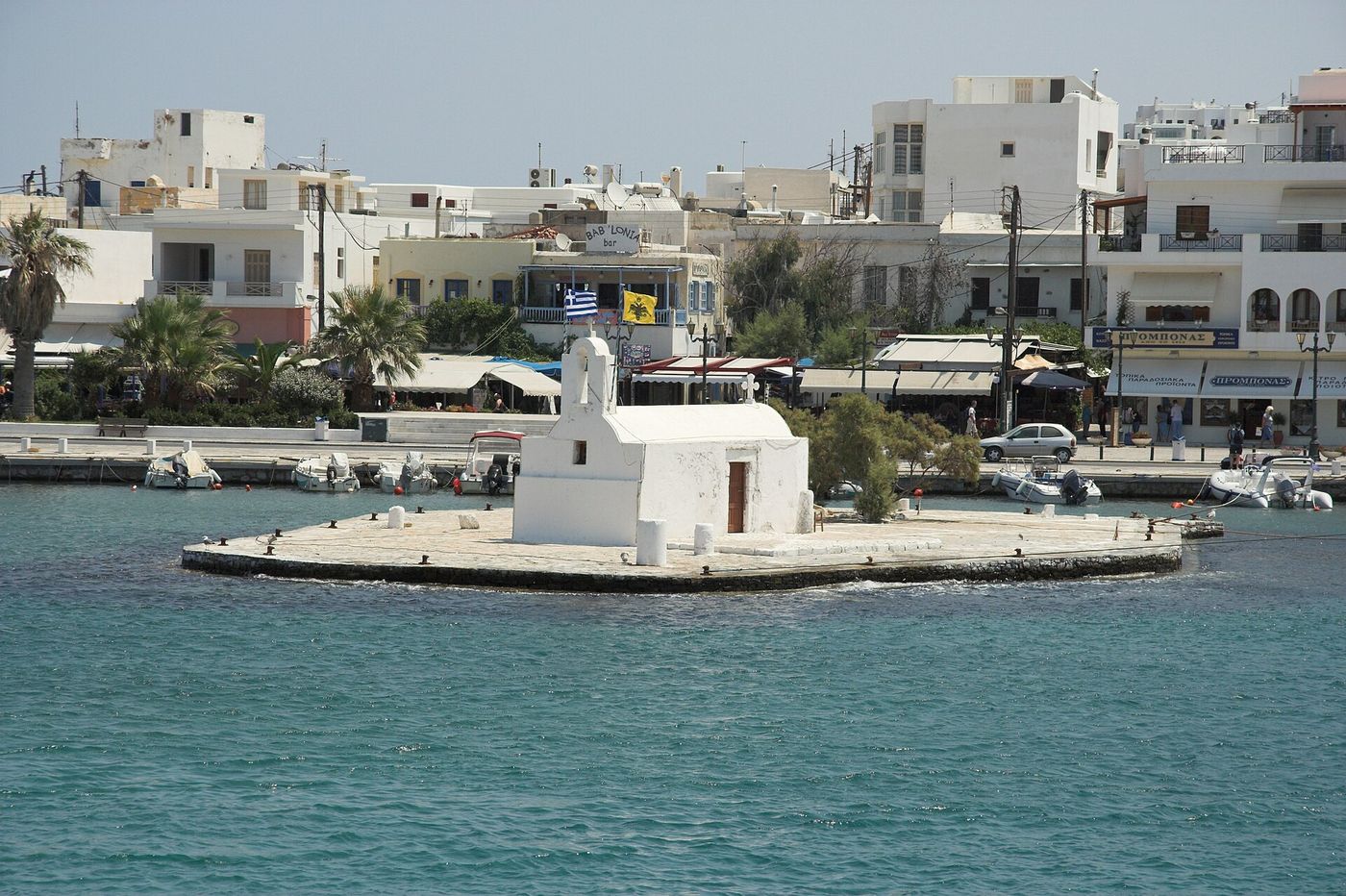
NAXOS, Greece — The water trucks still come to Naxos every morning, grinding up from the port to hotels whose cisterns ran dry in August. But on Saturday, for the first time, the island’s mayor had something else to show visitors: a fenced construction site above the beach at Agios Prokopios, where a desalination plant capable of producing 6,000 cubic meters of fresh water a day is to open by next June.
Greece’s government on Friday approved 210 million euros, about $227 million, in emergency funding for 31 desalination plants on islands across the Aegean, the largest single investment in the country’s water infrastructure in two decades. The decision followed a summer in which at least 14 islands imposed rationing and six, including Naxos, Sifnos and Leros, trucked or shipped in water at a cost the Interior Ministry put at 38 million euros.
“We had 3.1 million overnight stays on Naxos this year and a reservoir that was 14 percent full on Aug. 20,” said the mayor, Dimitris Lianos Kontopoulos. “You cannot run a destination on prayers for rain.”
The Cyclades received about 40 percent of their normal rainfall over the past two winters, according to the Hellenic National Meteorological Service, and groundwater levels on several islands have fallen to the point that wells are drawing brackish water. At the same time, Greece recorded a record 36 million international arrivals through September, up 5 percent from 2025, with the islands absorbing a disproportionate share. A single large hotel can use 600 liters of water per guest per day, roughly four times the consumption of a local household.
Desalination is not new to the Aegean; Syros has relied on it since the 1990s, and about 60 small units already operate across the islands. But most are undersized, and critics say the new program risks repeating old mistakes. “Many of these plants were built by municipalities that could not afford to maintain them, and half of them are running at reduced capacity because of broken membranes,” said Prof. Anastasia Katsarou, a hydrologist at the Agricultural University of Athens. “The money has to come with a maintenance contract, or we will be having this conversation again in 2031.”
The new plants will be powered partly by dedicated solar arrays, which the government says will reduce operating costs by about a third. Energy is the dominant expense in desalination, and Greece’s island grids, many still dependent on diesel generators, are among the most expensive in Europe.
On the Naxos site, the project manager, Yiannis Fragkoulis, said pipes and intake works would be completed before the winter storms. Asked what would happen if next summer was as dry as this one, he gestured toward the sea. “That,” he said, “does not run out.”
A version of this article appears in print on Oct. 11, 2026, Section A, Page 8 of the European edition with the headline: After a Summer of Dry Taps, Greek Islands Rush to Build Desalination Plants.