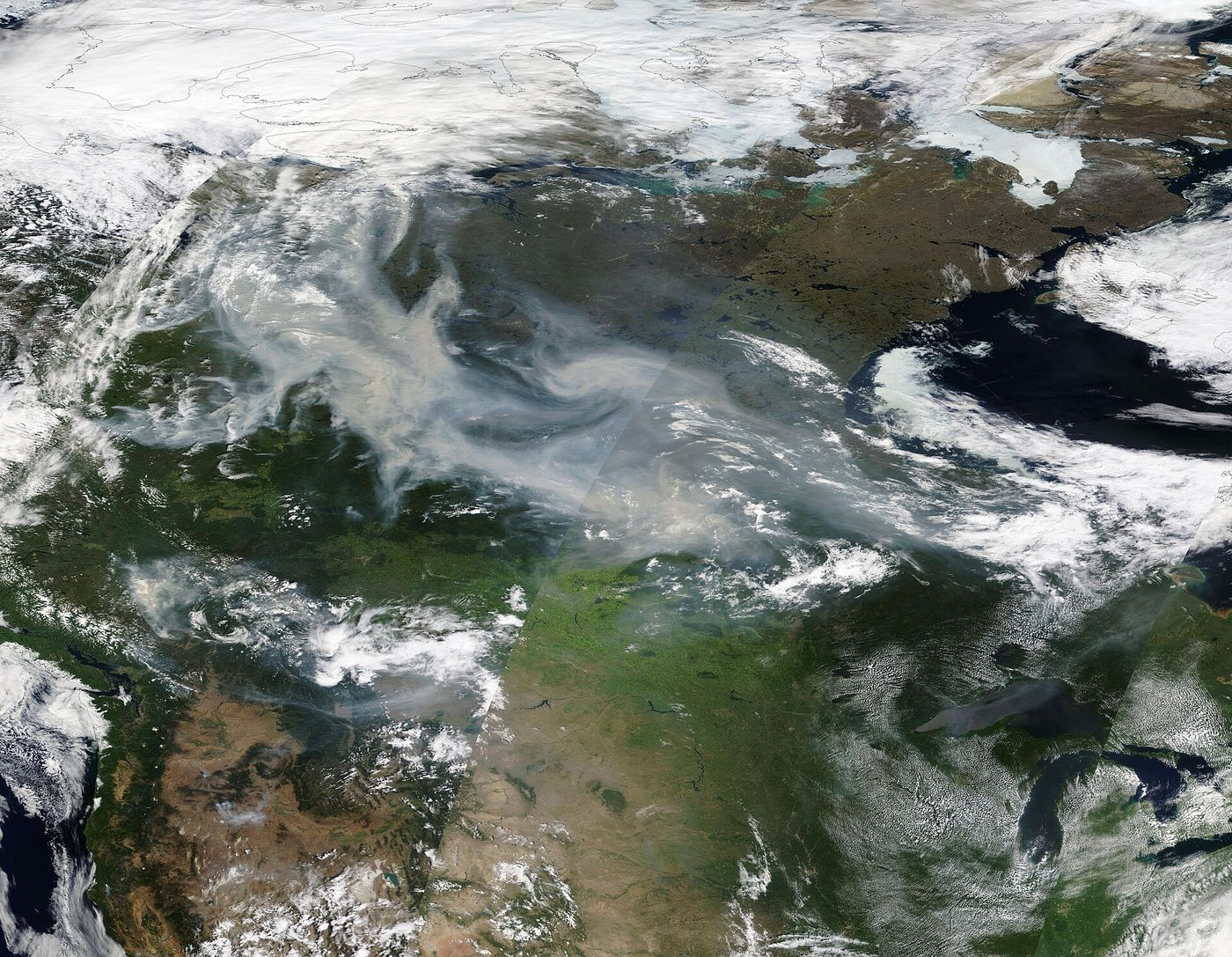
PRINCE ALBERT, Saskatchewan — Canada’s wildfire agencies declared the 2026 season effectively over on Friday, after the first sustained snowfall in the northern Prairies extinguished the last of the large fires, closing out a year in which 12.4 million hectares burned, the second-largest total since national record-keeping began in 1983 and nearly five times the 25-year average.
The season displaced about 110,000 people, mostly in Saskatchewan, Manitoba and northern Ontario, and destroyed roughly 1,900 structures, according to the Canadian Interagency Forest Fire Centre. Three firefighters died. It was the fourth time in five years that the area burned exceeded 5 million hectares, a threshold that had been crossed only three times in the preceding four decades.
“We no longer talk about bad years and good years,” said Marc-André Lefebvre, the center’s director of operations. “We talk about which provinces burn.”
The more lasting consequence of the season may be financial. The Insurance Bureau of Canada said on Thursday that insured losses from wildfire this year would exceed 3.2 billion Canadian dollars, about $2.3 billion, and that at least four insurers had stopped writing new home policies in communities within 10 kilometers of continuous boreal forest in Saskatchewan and Manitoba. In the town of La Ronge, which was evacuated twice this summer, residents report premium increases of 60 to 140 percent at renewal.
“I paid 2,100 dollars last year. This year the letter said 4,900, and I had to call three companies to find anyone who would take me,” said Darlene Morin, 57, a school custodian in La Ronge. “My house did not burn. My neighbors’ houses did not burn. We are being charged for a fire that did not happen yet.”
The retreat echoes developments in California and Australia, where insurers have withdrawn from fire-prone regions and governments have been forced to create backstop programs. Canada has no national equivalent. The federal government said in September that it was studying a public reinsurance facility for wildfire and flood, but gave no timetable.
Scientists say the trend is unlikely to reverse. Canada’s boreal forest is warming at about twice the global rate, and the fire season now begins about three weeks earlier and ends two weeks later than in the 1980s, according to Natural Resources Canada. “The forest is drying out faster than it can recover,” said Dr. Hannah Okonkwo, a fire ecologist at the University of Saskatchewan. “The communities inside it are making a bet that insurers are no longer willing to make with them.”
In Prince Albert, where smoke had at times cut visibility to a few hundred meters in July, the air on Saturday was clear and cold. The city’s fire chief, Robert Kowalczyk, said crews had already begun planning for next spring.
A version of this article appears in print on Oct. 11, 2026, Section A, Page 6 of the European edition with the headline: Canada Closes Its Second-Worst Wildfire Season on Record as Insurers Retreat From Forest Towns.