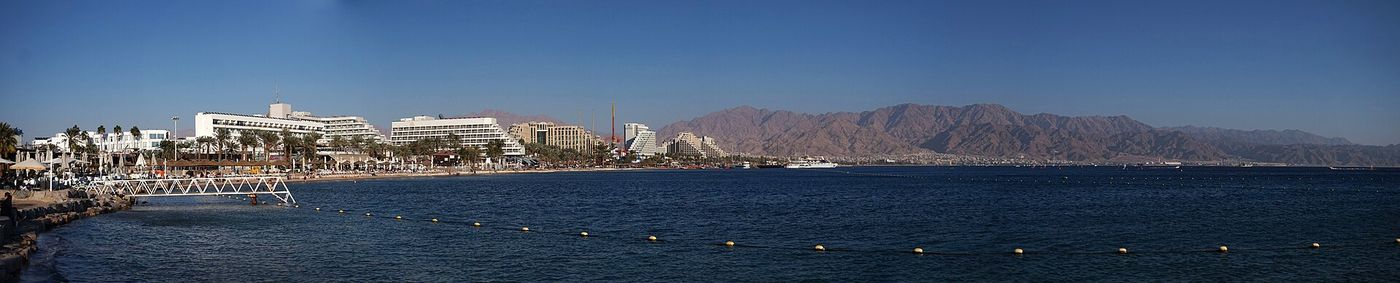
AQABA, Jordan — On a strip of coast south of Aqaba’s container port, earthmovers began on Saturday to level the site of what will be the Middle East’s largest desalination plant outside the Gulf, the first physical step in a project that Jordan has been planning, in one form or another, for 30 years.
The Aqaba-Amman Water Desalination and Conveyance Project will produce 300 million cubic meters of fresh water a year from the Red Sea and pump it 450 kilometers north, climbing about 1,000 meters through the desert, to the capital and the cities of the highlands where 80 percent of Jordanians live. The cost, including a 22-year operating contract awarded to a consortium led by a French water company, is estimated at about $5 billion, financed by loans and grants from the European Union, the United States, Germany and several development banks. First water is scheduled for 2030.
Jordan is among the most water-scarce countries on earth. Annual renewable water availability is about 60 cubic meters per person, far below the 500 cubic meters that the United Nations defines as absolute scarcity, and the figure has fallen by half since 1990 as the population has grown to 11.5 million, swelled by refugees from Iraq, Syria and elsewhere. Amman receives piped water once a week in most districts; residents fill rooftop tanks and ration. The aquifers that supply the capital are being drawn down at twice their recharge rate, and the Disi fossil aquifer on the Saudi border, tapped in 2013, is expected to be substantially depleted by the 2060s.
“This is not a project that makes Jordan comfortable. It is a project that keeps Jordan viable,” said Eng. Omar al-Majali, secretary general of the water ministry, at the site. “Without it, by 2035 we are rationing to levels no modern capital has seen.”
The engineering is formidable. The plant will draw about 600 million cubic meters of seawater a year, return the brine to the Gulf of Aqaba in a diffuser system designed to protect the coral reefs that are the basis of the city’s tourism economy, and consume about 600 megawatts of electricity, roughly a fifth of Jordan’s current demand. The ministry has contracted for 400 megawatts of new solar capacity to supply it, and the pipeline will include four pumping stations along the route through Wadi Araba and the plateau.
Marine biologists in Aqaba have raised concerns about the brine discharge. The northern Gulf of Aqaba hosts corals that have shown unusual resistance to warming and are studied as a possible refuge species. “The diffuser design is good on paper. The reef will tell us whether it is good in the water,” said Dr. Rania Shehadeh, who directs a marine science station near the site. The consortium has agreed to 10 years of independent monitoring.
The project’s longer history includes a plan, abandoned in 2021, to pipe Red Sea water to the Dead Sea to halt its decline and share desalinated output with Israel and the Palestinian territories. The current project is purely national, and the ministry says Jordan will pay about $1.70 per cubic meter for delivered water, roughly three times what Amman residents are charged today. Tariff reform is under discussion.
At a water tank distributor in East Amman, where residents buy tanker deliveries when the weekly supply falls short, Khalil Abu Zeid, 44, said he had heard about the pipeline since he was a boy. “Every government announces it,” he said. “This one has bulldozers. I will believe the rest when the tap runs on a Wednesday.”
A version of this article appears in print on Oct. 12, 2026, Section A, Page 12 of the European edition with the headline: Jordan Begins Building a 450-Kilometer Pipeline to Carry the Red Sea Uphill to Its Capital.



