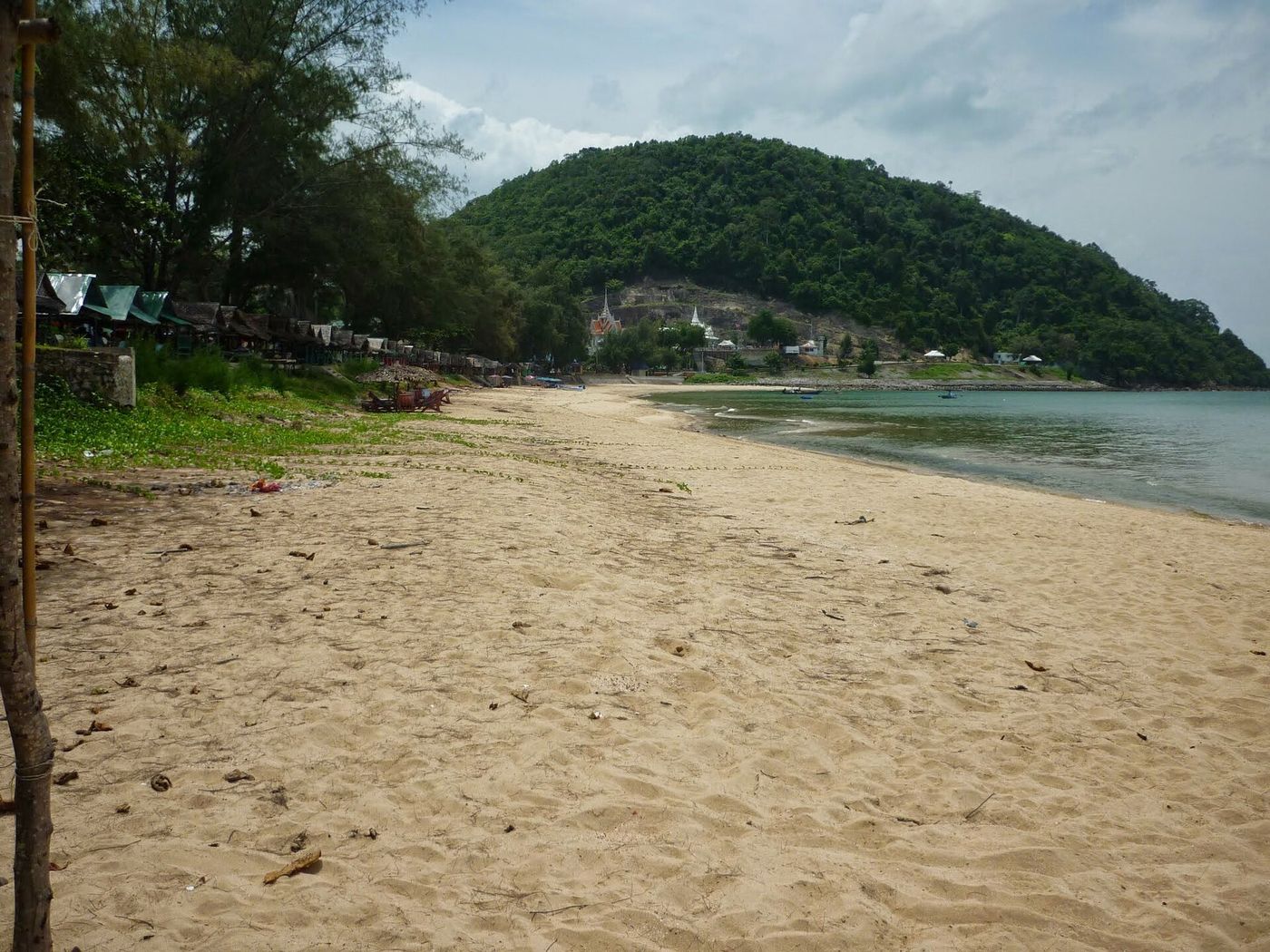
CHUMPHON, Thailand — The cove at Laem Riew is a crescent of white sand with 40 longtail boats drawn up above the tide line and a shrine to the sea goddess at the end of the pier. Under plans approved by the Thai cabinet last month, it will be the site of a 3-kilometer breakwater and a container terminal capable of handling 20 million containers a year.
Thailand’s land bridge project, a 1 trillion baht, or $28 billion, scheme to link a port on the Gulf of Thailand in Chumphon with one on the Andaman Sea in Ranong by a 90-kilometer motorway, dual-track railway and pipeline, has been discussed in some form since the 17th century, when European traders first imagined cutting across the Kra isthmus. The current government has made it the centerpiece of its infrastructure program, and the first phase, including both ports and the rail line, is scheduled to open in 2033.
The commercial argument is distance. A container ship from Singapore to the Indian Ocean must round the Malay Peninsula through the Strait of Malacca, a passage of about 1,200 kilometers that is among the most congested in the world. Transferring cargo across the isthmus by rail would, the transport ministry calculates, save two to three days and about 15 percent on shipping costs between East Asia and the Middle East and Europe. The ministry projects that the bridge would capture about 6 percent of Malacca traffic by 2040.
“Every ship that crosses here is a ship that no longer pays Singapore,” said Somchai Rattanakul, director of the project office in Bangkok, in an interview. “That is the point. That is also why there are people who would prefer this never gets built.”
Shipping economists are skeptical. Unloading and reloading containers twice adds cost and time that erode the saving, and the global shipping lines that would need to commit volumes have so far expressed interest without signing agreements. A study by a Singapore maritime institute estimated the break-even throughput at 12 million containers a year, a level reached by only a dozen ports in the world. The Thai government is seeking foreign investors to finance about 60 percent of the cost and has held roadshows in Dubai, Tokyo and Riyadh; it has announced no commitments.
On the coasts, opposition has organized. In Chumphon, a province whose economy rests on fishing, durian and a growing number of dive resorts, the provincial fisheries association says the Laem Riew terminal would destroy 4,000 hectares of sea grass and coral and displace about 1,100 households. In Ranong, the proposed western port would sit beside a mangrove reserve that is a candidate for UNESCO listing. “We have been given the full environmental report in Thai, 2,400 pages, with 30 days to respond,” said Wanida Srisawat, 44, who leads a group of fishing families in Laem Riew. “My father cannot read it. Neither can the ministers, I suspect.”
The government has promised compensation at 1.5 times assessed land values and a fund for new fishing harbors. The project also faces a feasibility question that has nothing to do with the coast: Thailand’s rail network runs on meter gauge, and the bridge would be built on standard gauge, meaning cargo could not simply continue inland.
At the shrine on the pier, Ms. Srisawat lit incense before taking her boat out. The goddess, she said, had seen off several ports already. “The Portuguese, the French, the Japanese. They all drew the line on the map,” she said. “The line is easy. The sea is not.”
A version of this article appears in print on Oct. 12, 2026, Section A, Page 6 of the European edition with the headline: Thailand’s $28 Billion ‘Land Bridge’ Promises to Bypass Malacca. Its Own Coast Is Not Convinced.



