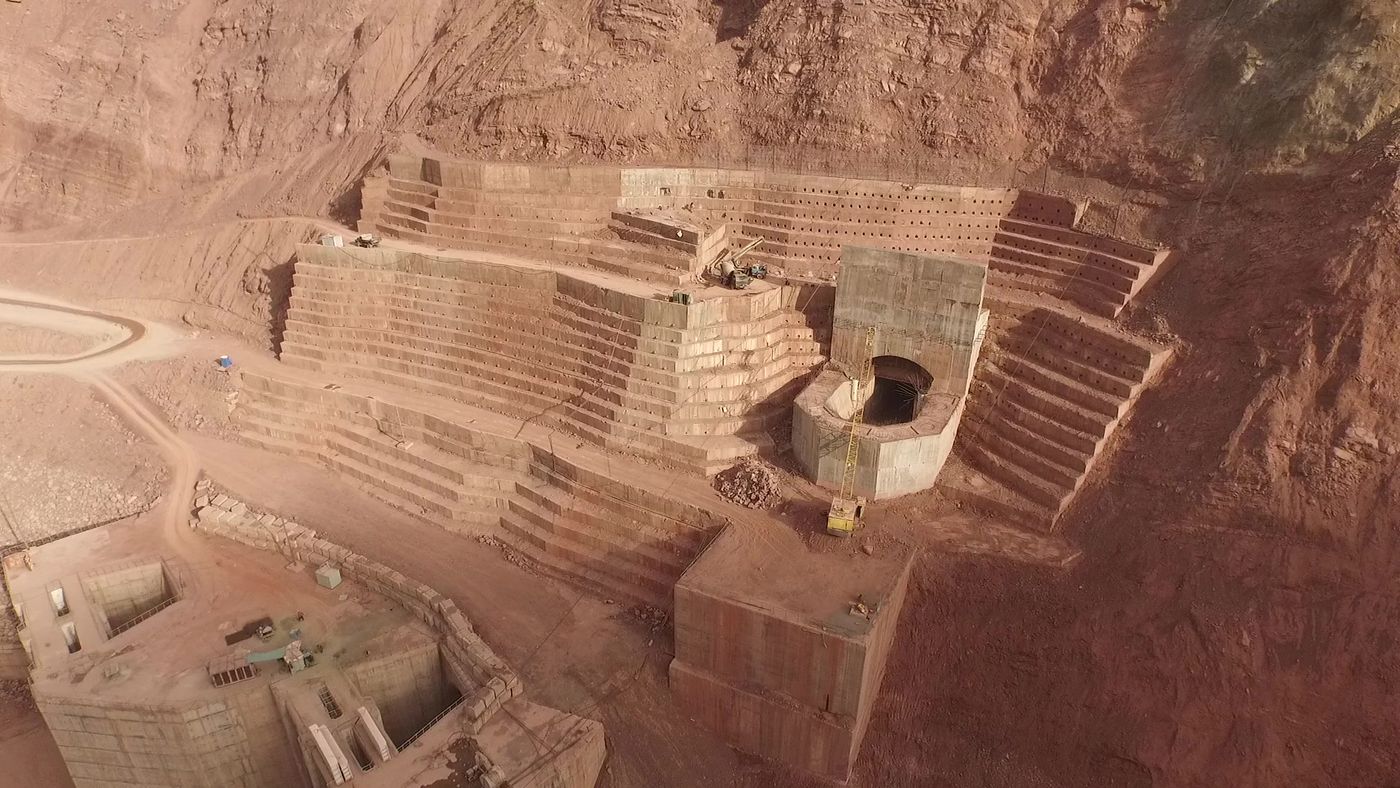
DUSHANBE, Tajikistan — The third of six turbines at the Rogun hydroelectric station began generating electricity on Thursday, adding 600 megawatts to a grid that has struggled every winter for two decades, and bringing a project begun by Soviet engineers in 1976 to roughly two-thirds of its planned output.
The dam, on the Vakhsh River about 110 kilometers east of Dushanbe, is already 240 meters high and will reach 335 meters when its rockfill embankment is completed, which would make it the tallest dam in the world. Its six turbines will produce 3,780 megawatts, nearly doubling Tajikistan’s generating capacity, and the government expects to export about 70 percent of the output to Uzbekistan, Kazakhstan, Afghanistan and Pakistan through a transmission line now under construction. The final cost is estimated at about $6.4 billion, financed by state budgets, bonds and, since 2024, loans from the World Bank and several development banks.
For Tajikistan, a mountainous country of 10 million people with the lowest per capita income in Central Asia, the dam has been a project of national identity as much as energy. Citizens were asked in 2010 to buy shares, and civil servants had purchases deducted from salaries. Posters of the dam are a fixture in government buildings. Spending on Rogun has accounted for about a quarter of all public investment in some years.
“Rogun is why Tajikistan has a winter,” said Firuza Nazarova, deputy chair of the state power company, who spoke at the commissioning ceremony. “Without it, we are a country that turns off its lights in November. With it, we are a country that sells light to our neighbors.”
Tajikistan has rationed electricity in winter for most of the past 20 years, with rural areas receiving power for as little as four hours a day. The shortage is seasonal: the country has abundant hydropower in summer but runs short when rivers freeze. Rogun’s reservoir, which will hold 13.3 cubic kilometers when full, is designed to store summer flow for winter generation. The reservoir has been filling since 2018 and is about 40 percent full; the power company says full winter reliability will require the fifth turbine, due in 2029.
The project has had critics. Uzbekistan, downstream on the Amu Darya, opposed the dam for two decades over fears that Tajikistan would restrict water for its cotton fields; the two countries reached an agreement on flow rules in 2018 and Uzbekistan is now a prospective buyer of the power. About 42,000 people have been resettled from the reservoir zone, and a report by an environmental group in 2025 found that resettled families in three districts had received land of poorer quality than they left. The World Bank has required a remediation plan as a condition of its lending.
Engineers also note that the dam sits in one of the most seismically active regions on earth and on a salt layer that must be continuously sealed to prevent erosion; the design includes a grout curtain and a drainage system the builders describe as the largest ever constructed.
In the town of Rogun, built for dam workers and now home to about 30,000 people, the ceremony was watched on screens in the central square. Daler Rahimov, 29, an electrician who has worked on the project since he was 19, said his father had worked on it, and his grandfather. “Three generations for one dam,” he said. “My son will see it finished. I hope he will do something else.”
A version of this article appears in print on Oct. 12, 2026, Section A, Page 5 of the European edition with the headline: Tajikistan Switches On a Third Turbine at Rogun, the Dam It Has Been Building for 50 Years.



