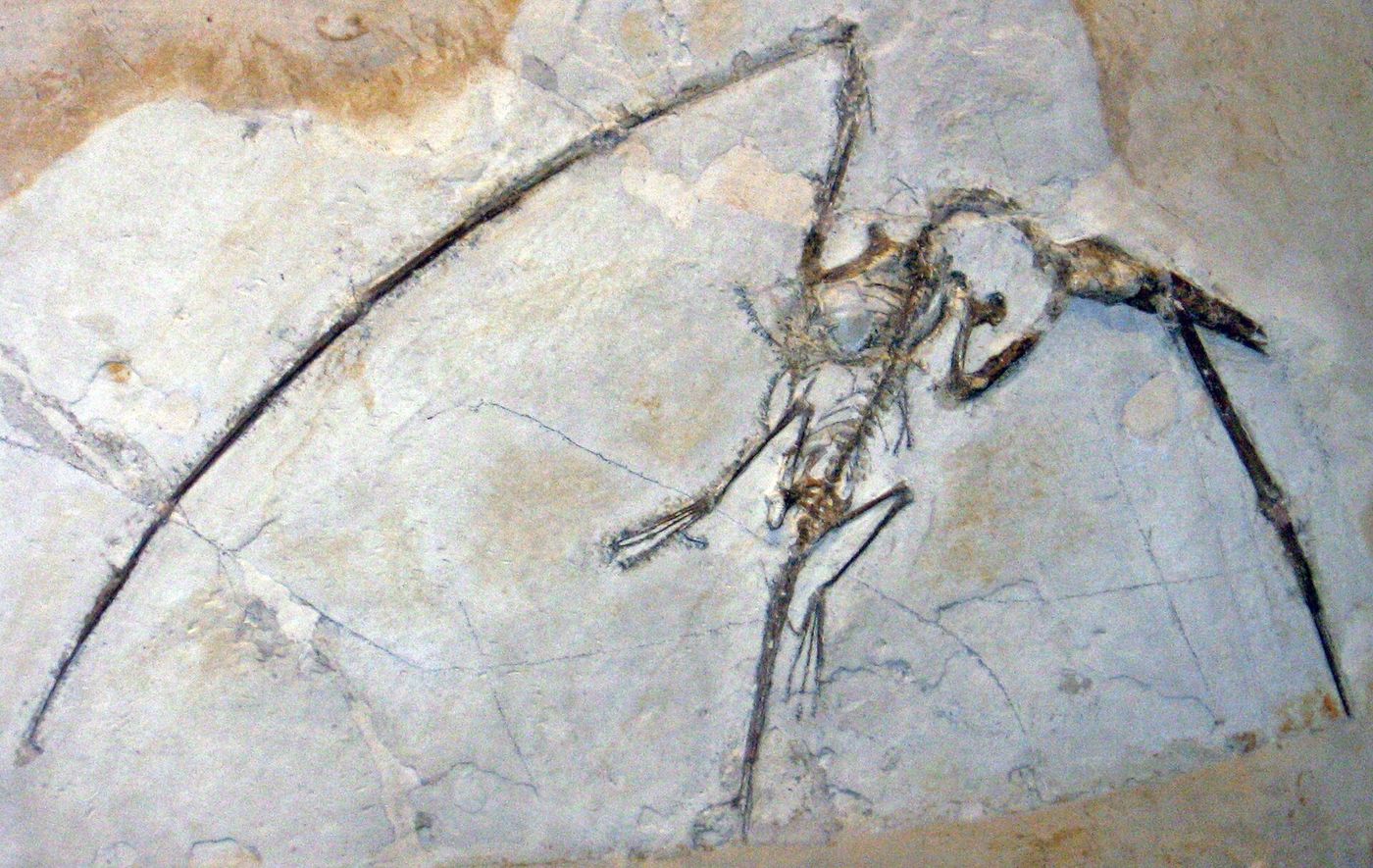
SOLNHOFEN, Germany — Georg Hiebl has split limestone in the quarries around this Bavarian town for 28 years, and he knows the sound of a slab that contains something. On a morning in July, the sound was right, and when the two halves fell apart he found himself looking at a creature with a long toothed snout, a wing finger folded like a closed umbrella, and, where its neck should have been, a fish.
The fossil, described on Wednesday in a paleontology journal, is a new species of pterosaur, the flying reptiles that shared the skies with early birds in the late Jurassic. It is about 150 million years old, had a wingspan of roughly 1.1 meters, and died with a fish about 12 centimeters long wedged in its throat, head first. The authors named it Lithoptera bavarica, “Bavarian stone wing.”
“We have pterosaurs with fish in their stomachs. We have pterosaurs with fish scales in their droppings. We do not, until now, have one that appears to have choked,” said Katharina Reuter, a paleontologist at the Jura Museum in Eichstätt who led the study. “It is a very sad fossil and a very useful one.”
The fish, identified from its scales and vertebrae as a member of the genus Leptolepides, a small herring-like species common in the Solnhofen lagoons, is oriented with its head toward the pterosaur’s stomach and its tail toward the mouth, the position in which a fish-eating animal swallows. Its size, about a third of the length of the pterosaur’s skull, is at the upper limit of what the animal’s throat could accommodate. Dr. Reuter’s team argues that it was the pterosaur’s final, fatal meal, though they acknowledge the animal could have died of other causes and the fish merely remained in place.
The Solnhofen limestone, laid down in still, oxygen-poor lagoons, has yielded some of the most finely preserved fossils in the world, including the early bird Archaeopteryx. Carcasses that sank into the lagoon floor were neither scavenged nor scattered, which is why a fish lodged in a throat could survive 150 million years.
Luis Ortega, a pterosaur specialist at the University of Zaragoza who reviewed the paper, said the new species filled a gap in the record of small, long-tailed pterosaurs just before they were displaced by larger, short-tailed forms. “The fish is what will make the newspapers,” he said. “The skull is what will make the textbooks.”
Mr. Hiebl, who under Bavarian law received a finder’s fee from the museum, has no strong view on the taxonomy. “I have found maybe 20 fish and three of those flying things,” he said. “This is the first time I found both in one stone.”
A version of this article appears in print on Oct. 12, 2026, Section A, Page 4 of the European edition with the headline: In a Bavarian Quarry, a Pterosaur With Its Last Meal Still in Its Throat.