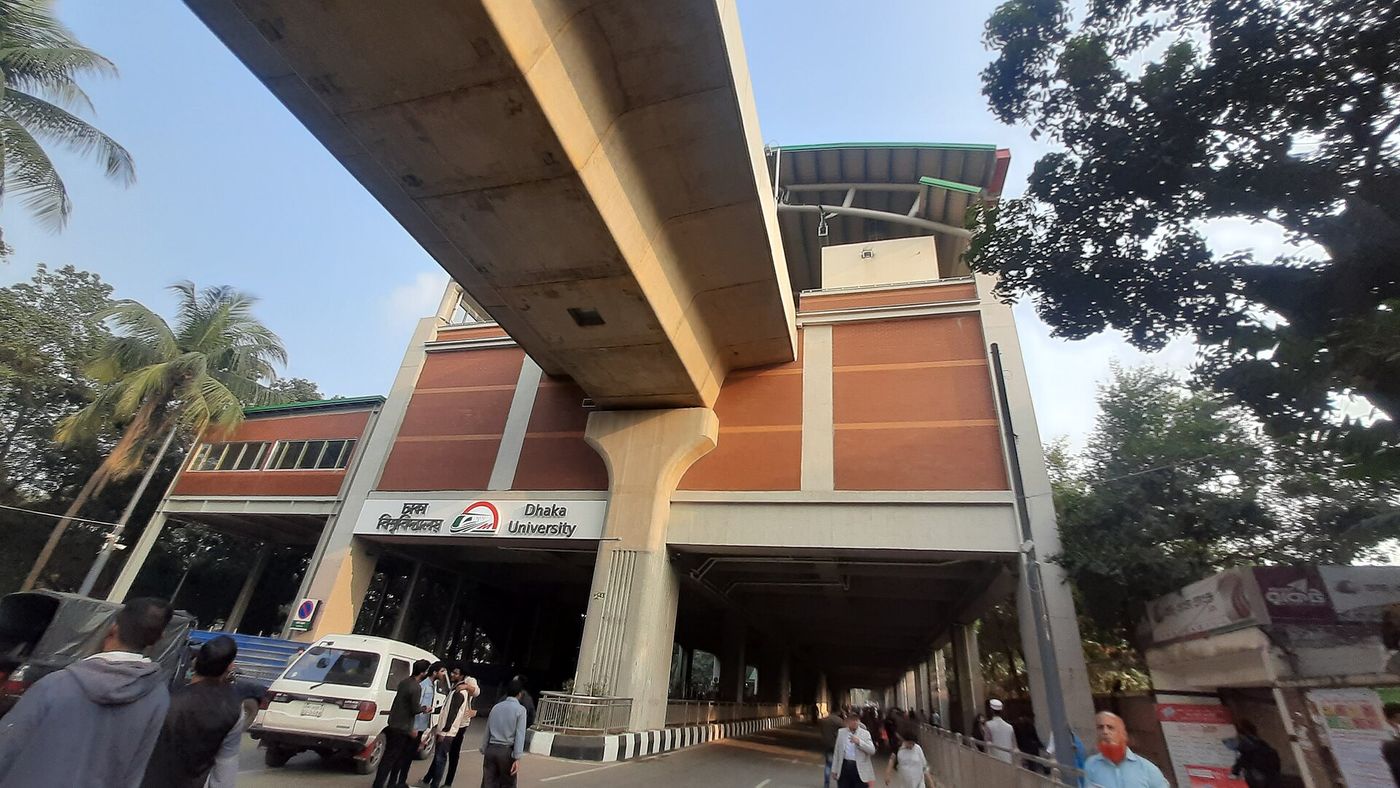
DHAKA, Bangladesh — At 7 a.m. on Sunday the first passengers rode an underground train in Bangladesh, descending beneath the airport road into a station with cooled air, escalators and, as several people remarked, no horns.
The second line of Dhaka’s metro, running 20 kilometers from the international airport to Kamalapur railway station on the edge of the old city, opened to the public after seven years of construction and a cost of about 520 billion taka, or $4.3 billion, most of it lent by Japan’s development agency. Roughly 13 kilometers of the route are underground, the first tunnels of their kind in the country. The line has 17 stations and will run trains every four minutes at peak hours.
Dhaka, home to more than 23 million people, has for years ranked among the slowest cities on earth to drive across; a 2024 study by a transport institute found that the average vehicle speed in the central districts was 4.8 kilometers an hour, slower than a brisk walk. The first metro line, opened in stages from 2022, now carries about 350,000 passengers a day on a 21-kilometer elevated route and has been credited with cutting travel time along its corridor by as much as 75 percent.
“Line 1 answered the question of whether Dhaka would ride a train. It did, on the first day,” said Farhana Yasmin, managing director of the metro authority. “Line 6 answers whether we can build under the city. We can.”
Engineers say tunneling through Dhaka’s soft alluvial soil, with a shallow water table and unmapped utilities, was the project’s chief difficulty. Two tunnel-boring machines from Japan advanced at an average of 9 meters a day, about half the planned rate, and the opening was pushed back 14 months. A contractor was fined after a section of road near Tejgaon subsided 30 centimeters in 2024.
The line was built with an eye to the capital’s garment trade. Three stations serve districts where a large share of the industry’s roughly 4 million workers live, and the authority has set the fare at 20 taka for the shortest trips, about 17 cents, lower than the first line. Monthly passes will be sold through factory payroll offices. “A worker on the night shift should not spend two hours on a bus,” said Ms. Yasmin.
Riders on the first morning were mostly curious rather than commuting. Shahidul Islam, 34, a motorcycle courier, rode the full line and back with his daughter. “I have driven this road for nine years. I know every pothole,” he said. “Today I went under it in 32 minutes, and I did not sweat.”
Two further lines are in planning, and the government has sought financing for a 48-kilometer orbital route. Critics note that the metro has so far reached neither the city’s poorest districts nor the industrial belt in Gazipur to the north. The authority says Gazipur is scheduled for 2031. “We are late,” Ms. Yasmin said. “The alternative was to never start.”
A version of this article appears in print on Oct. 12, 2026, Section A, Page 1 of the European edition with the headline: Dhaka Opens Second Metro Line, Betting Rail Can Unclog One of the World’s Slowest Cities.



