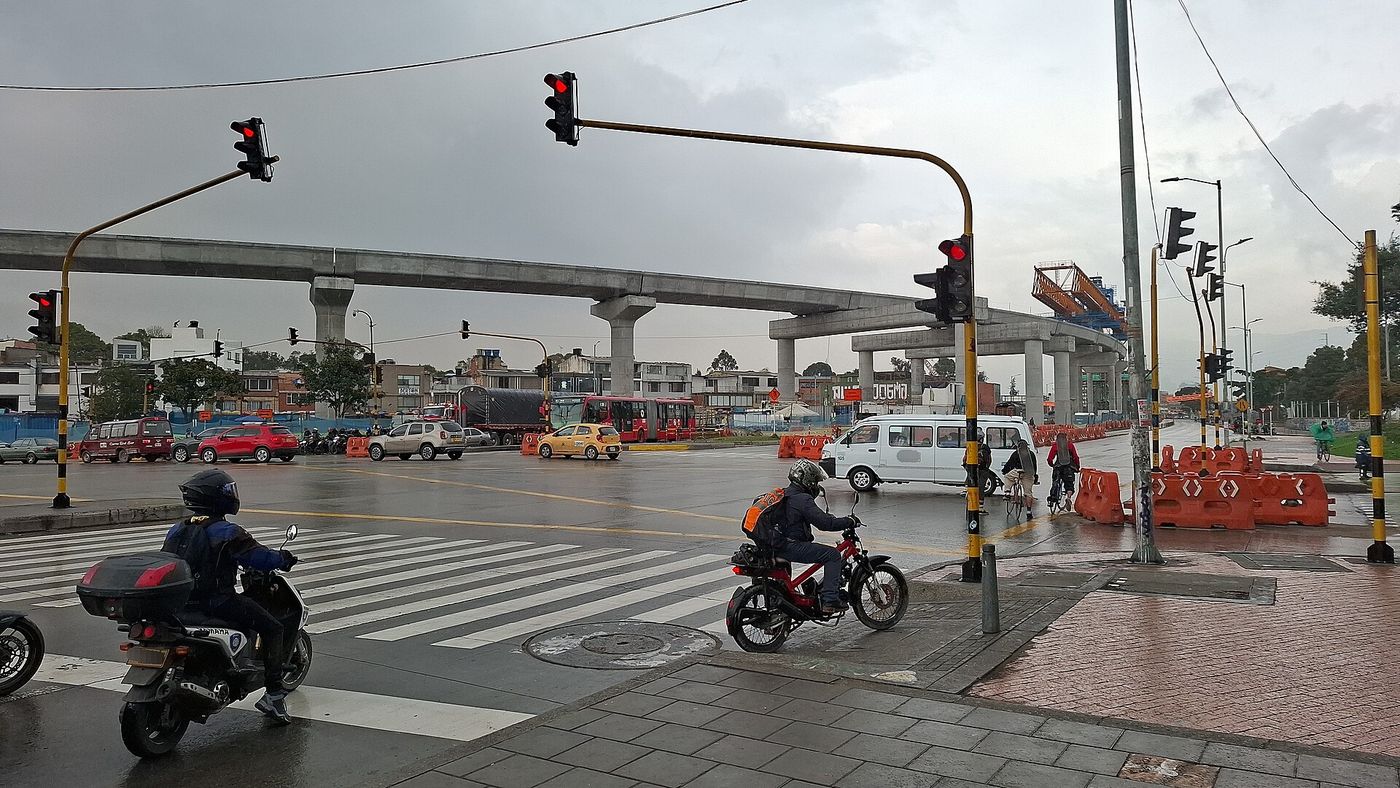
BOGOTÁ, Colombia — At 6:14 a.m. on Sunday, a white and blue train slid out of the Bosa maintenance yard on the southern edge of Bogotá, climbed onto a concrete viaduct 14 meters above the street, and traveled four kilometers at 35 kilometers an hour before stopping. Several hundred people who had gathered beneath the structure applauded. A few cried.
Bogotá has been planning a metro since 1942. Successive mayors have commissioned at least 14 studies, signed and canceled contracts, and buried the project under political rivalries and the city’s notorious clay soil. The capital of 8 million people has instead relied on TransMilenio, a bus rapid transit system that opened in 2000 and now carries 2.3 million riders a day at crush loads that are a staple of local complaint.
“I am 74 years old. My father talked about the metro,” said Hernando Pulido, a retired bus driver who arrived at 4 a.m. with a folding chair to watch from a pedestrian bridge. “I did not think I would see a train. I am going to ride it if I have to live to 80.”
The 24-kilometer first line, built by a Chinese-led consortium under a 15.8 trillion-peso contract, about $3.7 billion, is 78 percent complete, the city’s metro company said. Sixteen stations are under construction, and the first 10 of 30 trains have arrived by ship. The company said Sunday’s run was the first of a six-month program of tests that will gradually extend over the full viaduct, with passenger service planned for March 2028, roughly a year behind the original schedule.
The line is elevated rather than underground, a decision taken in 2017 that cut costs by an estimated 40 percent but divided the city. Critics say the viaduct has darkened Avenida Caracas, the main north-south artery, and displaced hundreds of businesses. Supporters argue that tunneling through Bogotá’s soft, water-saturated subsoil would have taken a decade longer.
“Every great city has a scar from building its metro,” said Diana Marcela Ospina, an urban transport engineer at the National University of Colombia. “Bogotá’s is visible. Paris’s and London’s are just older.”
The city projects that the line will carry 1 million passengers a day and cut average commutes along the corridor from 70 minutes to 27. It will connect to TransMilenio at 10 stations, and fares will be integrated. A second line, partly underground, is in design, and the national government has committed to fund 70 percent of it.
Street vendors along Avenida Caracas, many of whom lost their pitches during construction, are watching for a different payoff. “They said the stations would bring people,” said Yolanda Castañeda, who sells arepas near the future Calle 26 station. “We will see if the people have money when they come down.”
On Sunday, the train sat on the viaduct for several minutes after its run while engineers checked the braking data. Then it reversed slowly toward the yard, and the crowd below walked with it, keeping pace.
A version of this article appears in print on Oct. 12, 2026, Section A, Page 14 of the European edition with the headline: After 80 Years of Promises, Bogotá Runs Its First Metro Train.



