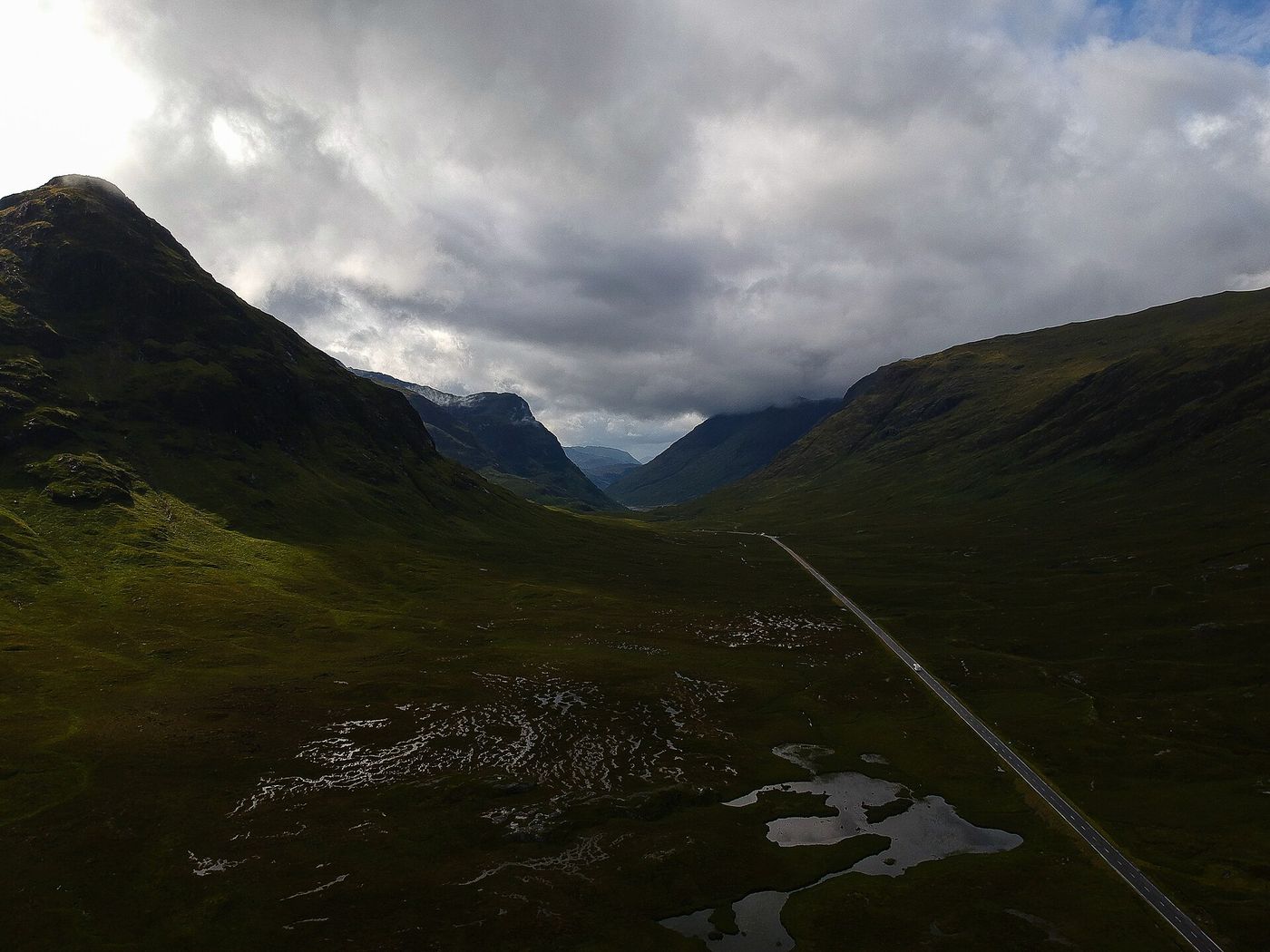
INVERNESS, Scotland — The field looks like every other field in the glen: rough pasture, a scattering of sheep, a burn running along one edge. Seen from an aircraft with a laser scanner, it looks like something else entirely: a rectangle of faint ditches, 23 hectares in extent, with the rounded corners and offset gateways that Roman soldiers dug by the thousand across Europe two millennia ago.
Archaeologists announced on Thursday that the enclosure, about 50 kilometers north of Inverness, is a Roman marching camp, the temporary fortified bivouac an army on the move built each night. It lies roughly 90 kilometers beyond the northernmost camp previously known and is large enough to have held about 20,000 troops, which would make it one of the biggest ever found in Britain.
“Every student is taught that Rome stopped at the Highlands. It seems Rome did not get that memo,” said Fiona Macrae, the archaeologist at Historic Environment Scotland who identified the site in lidar data collected for a national mapping program. “An army of 20,000 does not go for a walk. Someone was being chased, or someone was chasing.”
The find was made not by digging but by processing. Scotland completed an airborne laser survey of its entire land area last year, producing a terrain model accurate to a few centimeters that strips away vegetation and reveals earthworks the eye cannot see. Dr. Macrae and two colleagues have spent 18 months examining it for Roman features and have found 11 probable camps, of which the northern enclosure is by far the most significant.
Confirmation came in September from a small excavation across the ditch, which produced a characteristic V-shaped profile and a handful of iron hobnails of a type used in Roman military boots. Radiocarbon dates from charcoal in the ditch fill cluster around A.D. 80 to 90, the period of the campaigns led by the governor Agricola, which the historian Tacitus described as reaching the far north before the army was recalled.
“Tacitus was writing about his father-in-law, so historians have always discounted him by about a third,” said Alasdair Grant, a professor of Roman archaeology at the University of Aberdeen who was not involved in the discovery. “This camp suggests we may have been discounting the wrong third.”
Hamish Fraser, who has farmed the land for 35 years, said his family had always wondered why one corner of the field drained badly. “My father said it was the Romans. He was joking,” Mr. Fraser said. “I should ring him.” The site will be scheduled as a protected monument, and a larger excavation is planned for next summer.
A version of this article appears in print on Oct. 12, 2026, Section A, Page 4 of the European edition with the headline: Laser Survey Finds a Roman Marching Camp in the Highlands, Far Beyond Where the Legions Were Thought to Stop.