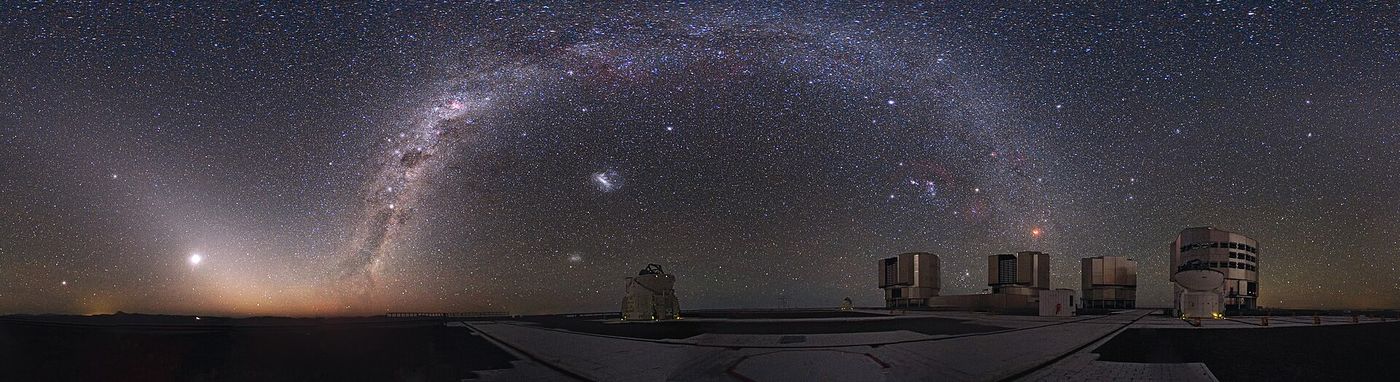
PARANAL OBSERVATORY, Chile — High on a mountain in the Atacama Desert, astronomers have spent every clear night for three weeks pointing some of the largest telescopes on earth at a dim smudge that was not born here. The object, designated 4I/Oyarzún, is only the fourth ever confirmed to have come from beyond the solar system, and it is doing something its predecessors did not do so obligingly: falling apart within reach.
The comet was discovered on Sept. 18 by a Chilean survey telescope and identified within days as interstellar by its speed, about 48 kilometers per second in excess of what the Sun’s gravity could explain. It will pass closest to the Sun on Nov. 19, at about 1.6 times the Earth’s distance, and then leave forever. Along the way it has begun to vent gas, and spectra taken here show that the gas is dominated by carbon dioxide, with far less water than a comet from our own system would show at the same distance.
“Three visitors in nine years, and this is the first one we have caught in the act of melting,” said Camila Oyarzún, the astronomer at the University of Chile who led the discovery team and for whom the object is named. “Every molecule we see was assembled around a different star. It is the closest thing to a sample return mission from another solar system that anyone alive will get.”
The nucleus is estimated at about 1.4 kilometers across, larger than the first interstellar object, which passed in 2017 and showed almost no activity, and comparable to the second, a comet seen in 2019. The third, found last year, was observed mostly from afar. 4I/Oyarzún, by contrast, will be visible to large telescopes for at least five months, and its outgassing is strong enough to be studied molecule by molecule.
The carbon dioxide is the puzzle. Henrik Lund, an astronomer with the European Southern Observatory, which operates the Paranal telescopes, said the ratio implied the object formed in a region far colder than the comets of our own outer solar system, or around a star whose chemistry was different. “Either it was born very far from its star, or its star was not like ours,” he said. “Both answers are interesting. We would prefer to know which.”
Priyanka Nair, a planetary scientist at Leiden University who is not part of the observing team, said the measurements could test models of how planetary systems form around stars of different masses and compositions. “We have one data point for how comets are made, and it is us,” she said. “A second data point changes the statistics more than any discovery since.”
The observing campaign now involves 14 telescopes on three continents and a space observatory that will begin infrared measurements next week. Dr. Oyarzún, who has slept in the observatory dormitory for 19 nights, said she would stay until the object dipped below the horizon in March. “It came a very long way,” she said. “The least I can do is stay up.”
A version of this article appears in print on Oct. 12, 2026, Section A, Page 11 of the European edition with the headline: A Visitor From Another Star Is Venting Carbon Dioxide, and Astronomers Are Racing to Catch It.