VENICE — The 78 yellow steel gates that lie on the seabed at the entrances to the Venetian lagoon were raised 71 times between last October and this April, the authority that operates them said this week, the most in any season since the barrier became operational in 2020 and nearly double the number its designers expected for a typical year.
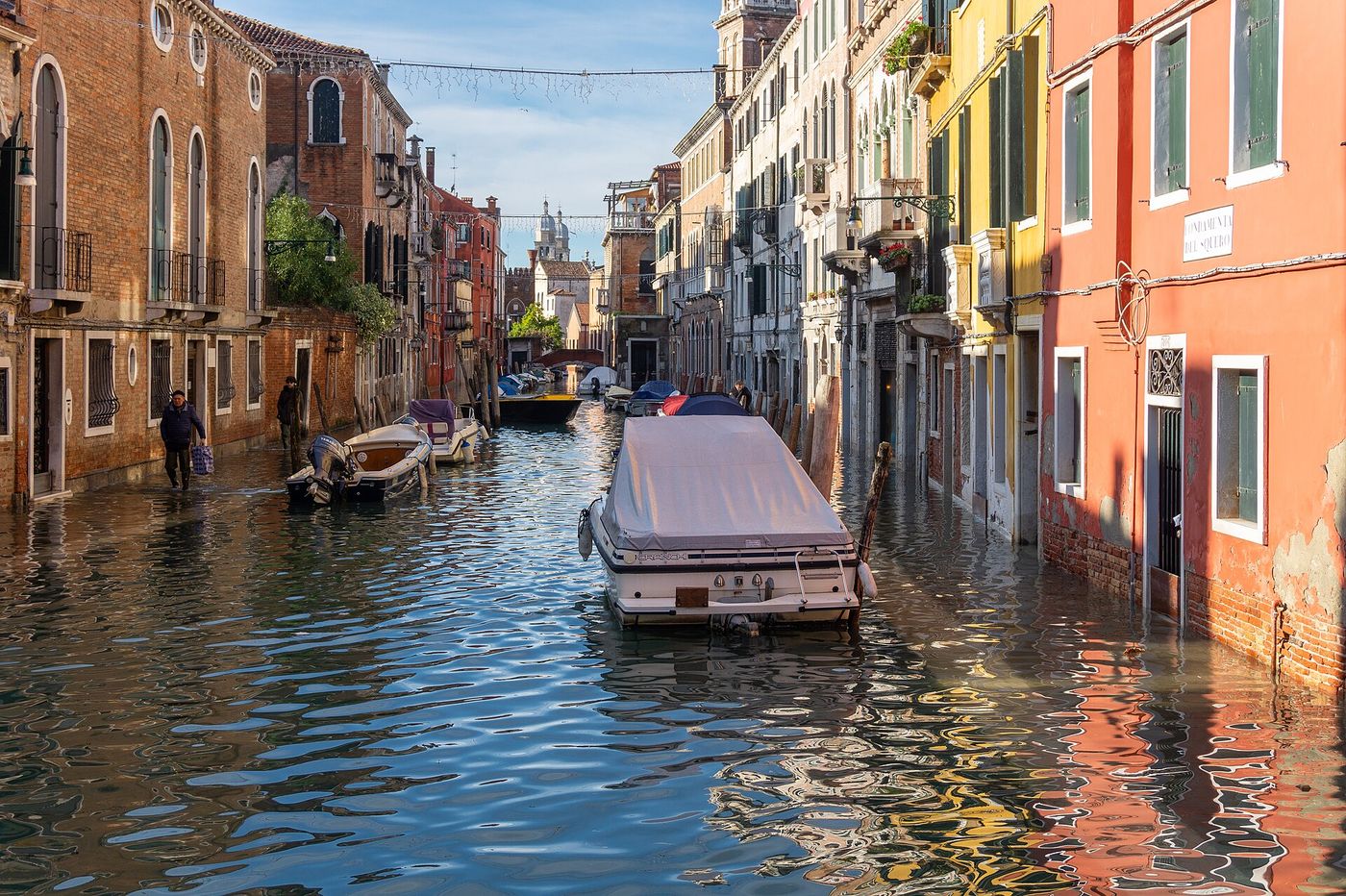
The system, known as MOSE, has transformed life in the city. The disastrous tide of November 2019, which put 85 percent of Venice underwater and ruined the crypt of St. Mark’s Basilica, has not been repeated, and shopkeepers in the low-lying districts around the square have put away the metal flood boards that once stood at every door. But the frequency of closures is raising questions about a structure designed in the 1980s for a sea that has since risen and a climate that delivers more of the autumn storms that drive water into the lagoon.
“The barrier was conceived for a few exceptional events a year,” said Chiara Zanon, an engineer who manages maintenance for the public authority that runs it. “We are now running it like a drawbridge.” Each closure requires about six hours of preparation and roughly 300,000 euros in energy, staff and wear, she said, and the gates, which are hollow and filled with compressed air to lift, are suffering corrosion and marine fouling faster than forecast. Replacing hinges on three gates this summer cost 24 million euros.
The authority has lowered the threshold at which it raises the barrier from 130 centimeters above the reference tide level to 110, after merchants argued that even “moderate” tides flooded St. Mark’s Square, which sits lower than the rest of the city. That change alone accounts for about half the extra closures. Scientists expect the trend to continue: the relative sea level in Venice, combining global rise and the slow sinking of the lagoon floor, has gone up about 35 centimeters since 1900 and is projected to rise a further 30 to 60 by 2100.
“At the upper end of those projections, the gates would be closed more than 200 days a year by the 2080s, and at that point you no longer have a lagoon,” said Prof. Luigi Dal Molin, an oceanographer at the Institute of Marine Sciences of Italy’s national research council. A closed lagoon cannot exchange water with the sea, he said, and would begin to stagnate within days. “MOSE buys the city 40 or 50 years. It is not a permanent answer, and nobody has started to design the permanent answer.”
The port is counting the cost now. Every closure stops shipping through the three inlets for the duration, and the Venice port association estimates that lost calls and delays cost its members 38 million euros last season. Roberto Scarpa, the association’s president, said cruise lines had already shifted most large ships to other Adriatic ports after a 2021 ban on vessels in the historic center, and that container and bulk operators were now weighing the same move. “A port that closes without 48 hours’ notice is not a port shipping companies plan around,” he said.
The city has begun a second line of defense inside the barrier, raising pavements in the lowest areas and installing a system of valves and pumps to protect St. Mark’s Square from tides below the closure threshold. A glass and steel wall around the basilica, completed in 2023, now keeps the crypt dry.
Ms. Zanon said her team would carry out the first full overhaul of the gates in 2028, an operation that will take four years and cost an estimated 400 million euros. “People think the barrier was the end of the story,” she said. “It was the start of a maintenance contract that will outlive everyone in this office.”
A version of this article appears in print on Oct. 12, 2026, Section A, Page 14 of the European edition with the headline: Venice’s Flood Barrier Rose a Record 71 Times Last Season. Keeping It Up Is Getting Expensive..