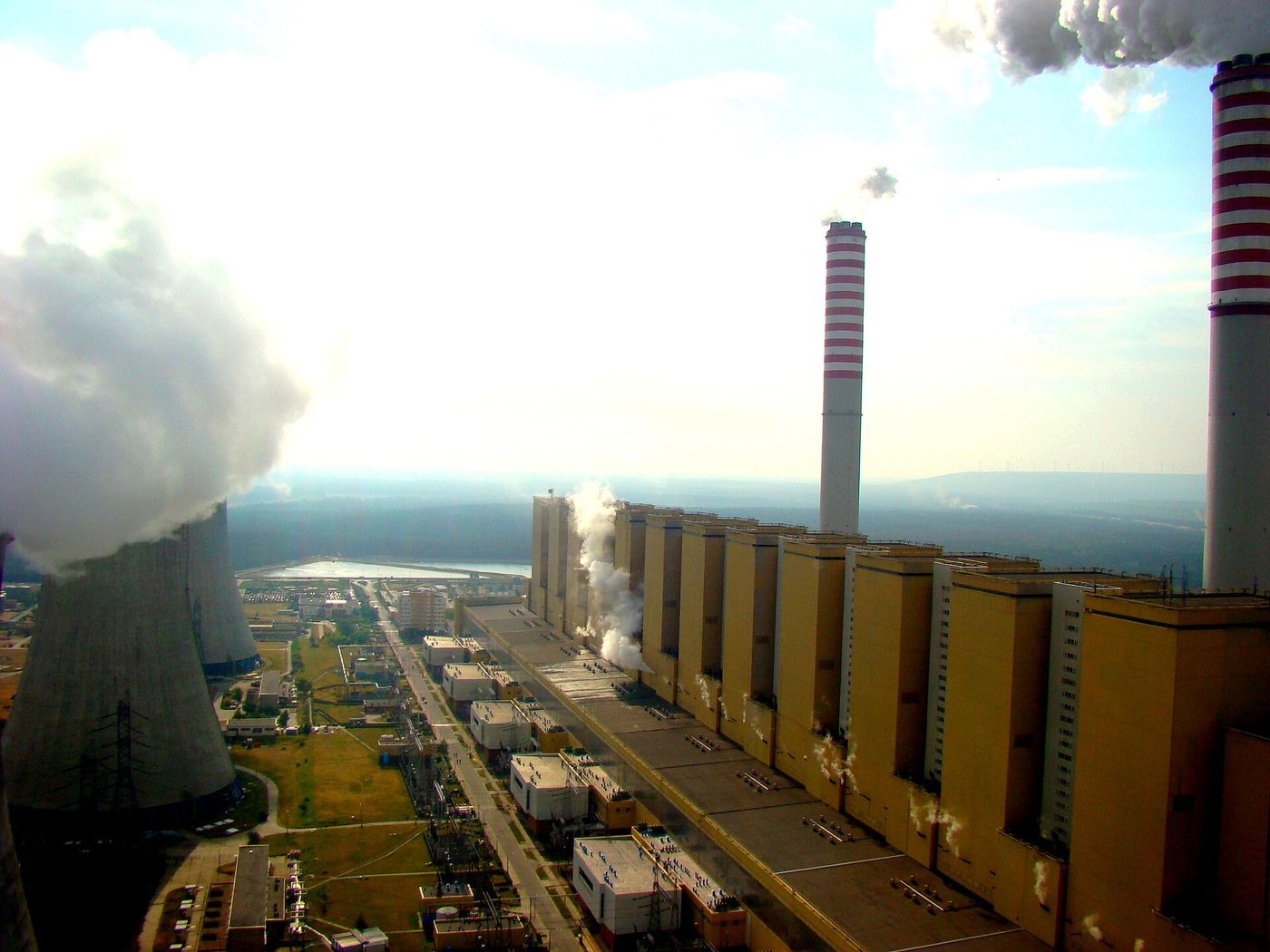
BEŁCHATÓW, Poland — For 40 years, Krzysztof Wasilewski has set his watch by the shift sirens at the Bełchatów mine, a hole in the Polish plain 12 kilometers long and 300 meters deep that feeds the largest coal-fired power station in Europe. On a gray morning this month, he stood at the lip of the pit and pointed to the far wall, where the brown seam of lignite thinned to nothing. “That is the end,” he said. “You can see it from here. We used to only talk about it.”
Bełchatów, a town of 55,000 people that did not exist in its current form before the mine opened in 1980, is the center of the most consequential energy transition in Central Europe. The power station’s 12 units once supplied a fifth of Poland’s electricity and emitted more carbon dioxide than any single site on the continent. The state-owned operator shut down four units in the past two years and plans to close the rest by 2036, when the economically recoverable coal will be exhausted. The company says a decision on whether to accelerate that timeline will come early next year.
The plant and mine employ about 7,000 people directly, and the regional labor office estimates that another 12,000 jobs in the surrounding Łódź province depend on them. Poland’s share of a European Union fund for coal regions has allocated the province about 370 million euros, and the first retraining programs, funded by the operator, have enrolled 1,400 workers in courses on wind turbine maintenance, welding and electrical installation.
“The money is real. The jobs are theoretical,” said Mr. Wasilewski, 51, who also heads a local branch of the miners’ union. A mine electrician earns about 11,000 zlotys a month, roughly 2,500 euros, well above the regional average; the wind-farm maintenance jobs that retrained colleagues have found pay about 60 percent of that and are mostly in the north, near the Baltic coast. “Nobody is going to build a factory here because a brochure says we have skilled workers,” he said. “They will build it if the power station site has a grid connection and a road.”
On that point, the town and the operator agree. The site has a connection to the national grid rated at more than 5 gigawatts, among the largest in Europe, and the company has announced plans for a 600-megawatt solar farm on reclaimed mine land, a battery storage facility and, more tentatively, a gas-fired plant that could later burn hydrogen. A government feasibility study on a small modular nuclear reactor on the site is due next year.
Agnieszka Dobrowolska, the town’s deputy mayor, said the local authority had spent the past three years assembling a 400-hectare industrial zone next to the plant and courting battery and electronics manufacturers, so far without a signed deal. The town’s budget depends on the plant for about a third of its tax revenue. “We have a decade,” she said. “That sounds long until you learn that a factory takes five years to permit and build, and nobody is signing in year one.”
Analysts say Bełchatów’s fate will set the template for the rest of Poland, which still generates about 55 percent of its electricity from coal, the highest share in the E.U., and employs 75,000 miners, mostly in Silesia. “Silesia is watching Bełchatów to see whether the promises are kept,” said Dr. Marcin Zaręba, an energy analyst at a Warsaw research institute. “If this town ends up as a solar farm and a bus to Łódź, the political fight over Silesia will be far uglier.”
At the mine’s main gate, a digital sign that once displayed daily output now shows the date. Mr. Wasilewski said younger workers had started leaving for Germany and the Baltic shipyards, and that his own son, an engineer, worked in Gdańsk. “I will be here until they turn out the lights,” he said. “Somebody has to.”
A version of this article appears in print on Oct. 12, 2026, Section A, Page 17 of the European edition with the headline: Europe’s Biggest Coal Plant Is Winding Down. The Town Built Around It Is Looking for a New Reason to Exist..