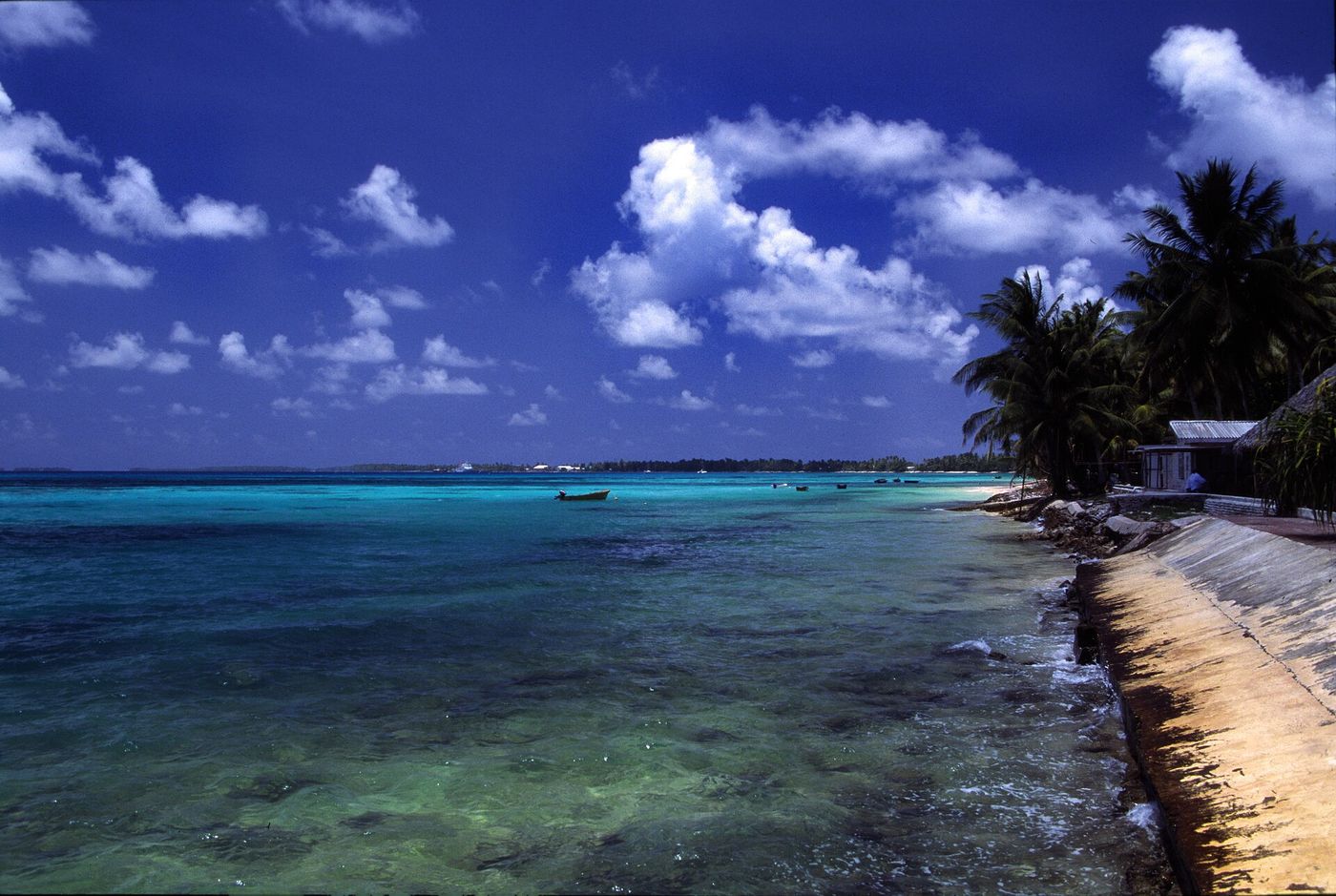
FUNAFUTI, Tuvalu — The departures lounge at Funafuti’s airport is a shed beside the runway that doubles, between flights, as the island’s football pitch. On Tuesday mornings, when the plane to Fiji leaves, it has become the place where this country of 10,000 people says goodbye.
Under a treaty with Australia that came into force last year, up to 280 Tuvaluans a year, chosen by lottery, receive permanent residence in Australia with the right to work, study and return home freely. It is the first visa in the world granted explicitly in recognition of climate change. Tuvalu’s nine coral atolls rise no more than about 4 meters above the sea, and government projections based on current emissions suggest that much of Funafuti will be below the high-tide line by 2100. More than 8,700 people, well over half the country, applied for the first ballot.
The first cohort has now been in Australia for just under a year, and the Tuvaluan government published its first review of the program on Friday. Of 280 recipients, 231 had moved, most to Brisbane, where a church with Tuvaluan congregants has become an informal resettlement office. Eighty-four percent of adults were in work, mostly in aged care, construction and food processing, and remittances to the island had risen by about 2.4 million Australian dollars, or $1.6 million, roughly 5 percent of Tuvalu’s gross domestic product.
“The treaty was negotiated as an insurance policy. What we are learning is that insurance changes how you live before the disaster,” said Fatasi Malologa, the secretary of Tuvalu’s home affairs ministry, who wrote the review. “We are a nation that now has a door, and everyone can see it.”
On Funafuti, the effects are domestic rather than dramatic. The hospital has lost two of its seven nurses. The primary school on the outer island of Nanumea closed a classroom after six families left. The price of a used motorcycle has fallen by a third because departing families sell quickly. At the same time, remittance money has paid for new water tanks and solar panels on roofs across the atoll, and the national bank reported a 19 percent rise in deposits.
Tulia Paeniu, 34, a schoolteacher, won a place in the second ballot in July and will leave in January with her two children. Her husband, a fisherman, will follow if he finds work. “I am not leaving because the sea is at the door. I am leaving because my daughter is 9 and I want her to have a choice I did not,” she said. “People say we are abandoning the island. The island will still be here in my lifetime. I am going so there is someone to send money to keep it.”
The treaty also commits Australia to defend Tuvalu in the event of a military threat or natural disaster, and gives Canberra a say over any security arrangement Tuvalu makes with a third country, a clause widely understood to refer to China. Critics in the region have called it a sovereignty trade. Tuvalu’s government says it was the price of a guarantee, and that the alternative was none.
At the airport on Tuesday, Ms. Paeniu’s students had come to see off a classmate. They sang, then played football on the runway until the plane came in. “We practice,” one of the boys said, “for when it is our turn.”
A version of this article appears in print on Oct. 12, 2026, Section A, Page 9 of the European edition with the headline: A Year Into the World’s First Climate Visa, Tuvalu Weighs What It Means to Leave Slowly.



