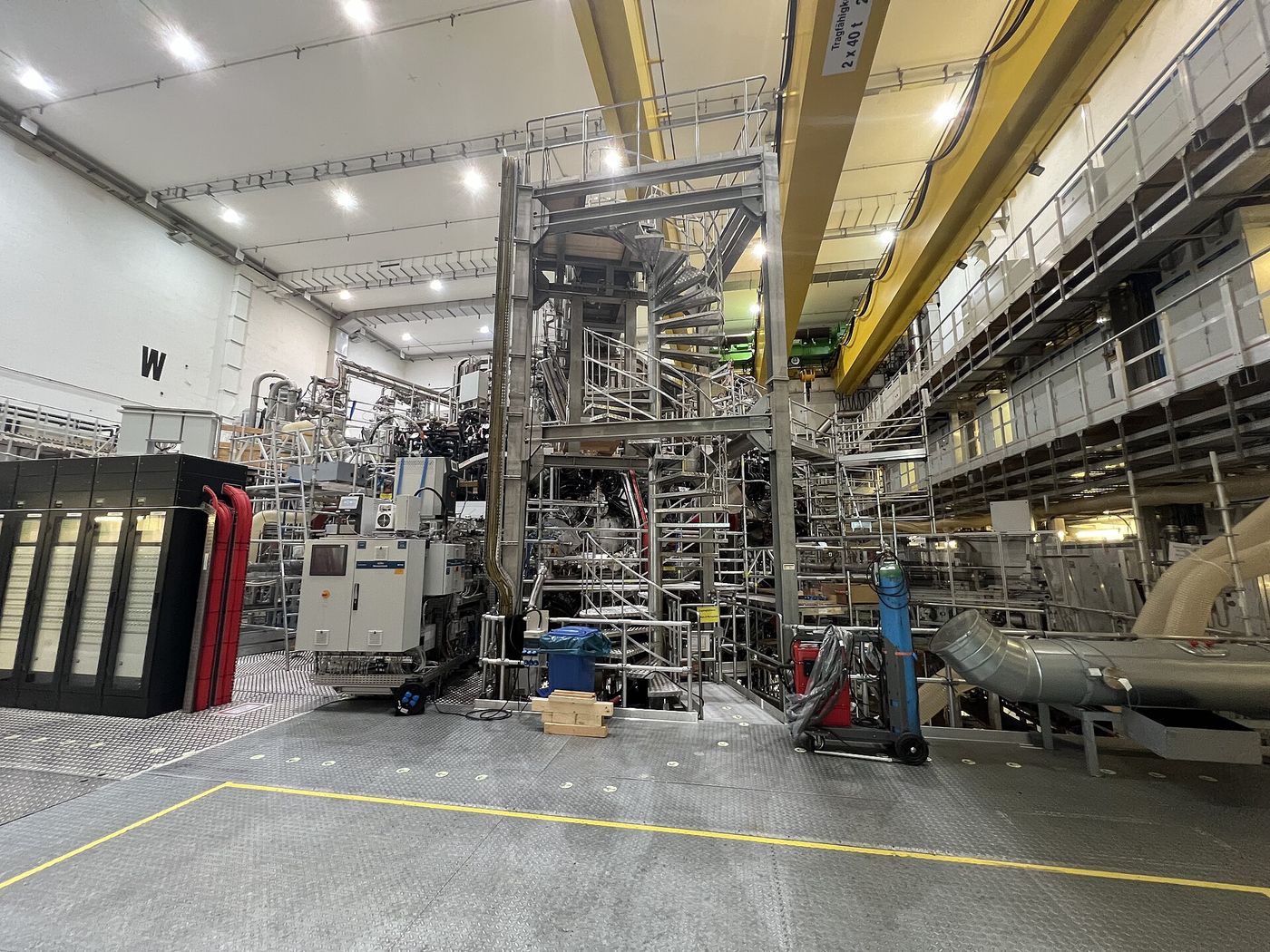
GREIFSWALD, Germany — For 480 seconds on Tuesday afternoon, a ring of hydrogen gas hotter than the center of the Sun hung inside a twisted steel chamber on the Baltic coast, held in place by magnetic fields and nothing else. When it finally dissipated, the control room of the Wendelstein 7-X stellarator broke into applause. The previous record at the machine was 43 seconds.
The experiment, conducted by the Max Planck Institute for Plasma Physics, which operates the device, injected a total of 1.3 gigajoules of heating energy over eight minutes while keeping the plasma at about 30 million degrees Celsius. No machine of its type has sustained a hot plasma for so long, and few fusion devices of any design have.
“The point of a stellarator was always that it should run forever, in principle,” said Ulrike Brandt, the physicist who led the experimental campaign. “The problem was that for 60 years nobody could build one well enough to find out. Today we found out for eight minutes.”
Stellarators and tokamaks, the two main designs for magnetic fusion, confine plasma in a ring. Tokamaks, which include the large international reactor under construction in France, use a current driven through the plasma itself to help hold it, which makes them simpler to build but prone to sudden collapses and difficult to run continuously. Stellarators use external magnets of fiendishly complex shape to do the whole job, which makes them inherently steady but was, until recently, nearly impossible to engineer precisely.
Wendelstein 7-X, whose magnets were designed by supercomputer and took 19 years to construct, is the test of whether that trade-off has flipped. Tuesday’s run suggests it has. The plasma density and temperature were still far below what a power plant would require, Dr. Brandt stressed, and the machine produces no net energy. But the duration demonstrated that the exhaust system, which removes heat and impurities, could cope with sustained operation, a problem that has limited other devices.
“Everyone in this field will tell you that duration is the boring parameter, until they cannot achieve it,” said Yasmin El-Sayed, a fusion scientist at the Culham Centre for Fusion Energy in Britain who was not involved in the experiment. “A power plant has to run for months. This is the first machine to make that look like an engineering question rather than a physics question.”
Three private companies, in the United States and Germany, are now designing stellarator-based power plants, and the Greifswald result will feature in their fund-raising. Tobias Kern, the institute’s deputy director, said the lab’s next goal was 30 minutes, the design limit of the machine’s cooling system, by 2028.
Dr. Brandt, asked what she did when the plasma ended, said she checked the data twice and then went outside. “It was raining,” she said. “I had forgotten there was weather.”
A version of this article appears in print on Oct. 12, 2026, Section A, Page 12 of the European edition with the headline: A German Fusion Machine Holds a Plasma for 8 Minutes, Its Longest Yet.